The FDA Codes Keeping Your Meals Safe

I’ve stood at a deli counter plenty of times, watching someone slice turkey, wrap a sandwich, and hand it across with the same gloves he just used to slice the previous customer’s cheese. The case looks clean. The guy smiles. Meanwhile my daughter is tugging my sleeve asking for a pink cookie on display, and I’m mostly thinking about whether they’ll actually eat what I buy, not the temperature of the refrigerator behind him.

But that refrigerator temperature probably matters more than anything I can see.

What you see at a restaurant or deli is maybe 10% of food safety regulations in place to keep our food safe.

The other 90% happened before you walked in: was a sick employee sent home, was yesterday’s soup cooled fast enough, was the cutting board wiped down between an allergen and your kid’s sandwich? Food safety is a little like plumbing: when it works, you don’t think about it. You turn on the faucet and clean water comes out. You order lunch and assume it’s safe.

We play offense by playing defense

It’s easy to think of food regulation as reactive: a recall happens, then rules change.

The 2026 FDA Food Code works the opposite way, and that’s the most important thing to understand about it.

This isn’t a new rulebook. The FDA has updated the Food Code every few years since the 1990s.

The basics have been in place for decades: cook foods to the right temperature, keep hold hot foods hot and cold foods cold, wash hands, sanitize surfaces.

Those fundamentals are why America has one of the safest food supplies in the world.

Even with an estimated 800 foodborne illness outbreaks a year, the system works for more than a million restaurants, grocery stores, schools, hospitals, nursing homes, and childcare centers.

The 2026 edition doesn’t throw that foundation out. It asks a harder question:

What needs to be written down, systematized, and verified so safety doesn’t depend on a tired manager making a perfect call on a busy Saturday night?

Glenda Lewis, FDA’s director of Retail Food Protection, has described the Code as “practical science-based guidance for mitigating risk factors that are known to cause foodborne illness” and “an important part of strengthening the national food safety system.”

Think of it like football. The Food Code isn’t the highlight reel, it’s the offensive line. You only notice it when it fails. Releasing an update before the next crisis, rather than after it, is the government playing defense on purpose.

What’s new, in plain English

The Code is a model. States and localities adopt it jurisdiction by jurisdiction, so a new edition doesn’t become law everywhere overnight. But its direction matters. The 2026 changes boil down to three shifts:

1. From rules to systems

For the first time, the Code formally defines a Food Safety Management System (FSMS) and will require many establishments to have one in writing within four years of their state adopting it. It also adds “food defense,” protecting food from intentional contamination and makes the person in charge explicitly responsible for active managerial control.

Translation: the fridge gets checked because someone owns checking it, not because someone remembered.

2. From improvising to writing it down

New requirements for written employee illness policies, reorganized procedures for vomiting and diarrheal events, plus clarifications on glove use, sanitizer temperatures, and cooling.

Translation: Sanitation procedures look mundane on paper, but  necessary in a kitchen.

3. Keeping up with how we eat now

Guidance for dehydration and freeze-drying in restaurants and retail, hazards for raw specialty mushrooms, clearer language on allergen cross-contact, new definitions for mobile food establishments, food trucks and provisions for food donations.

Translation: The pantry has changed; the rulebook is catching up.

The soup problem

Unlike the Thanksgiving turkey carcass left on the counter “to cool a bit” before refrigerating, a 20-gallon stockpot of soup in a restaurant walk-in has a very different cooling pattern. The outside cools first. The center can stay warm for hours, right in the zone where bacteria multiply, even though the soup was perfectly cooked earlier.

Food safety is a relay race. Cooking runs one leg well, then hands the baton to cooling, refrigeration, clean equipment, and hygiene. A fumble on any later leg undoes the earlier work.
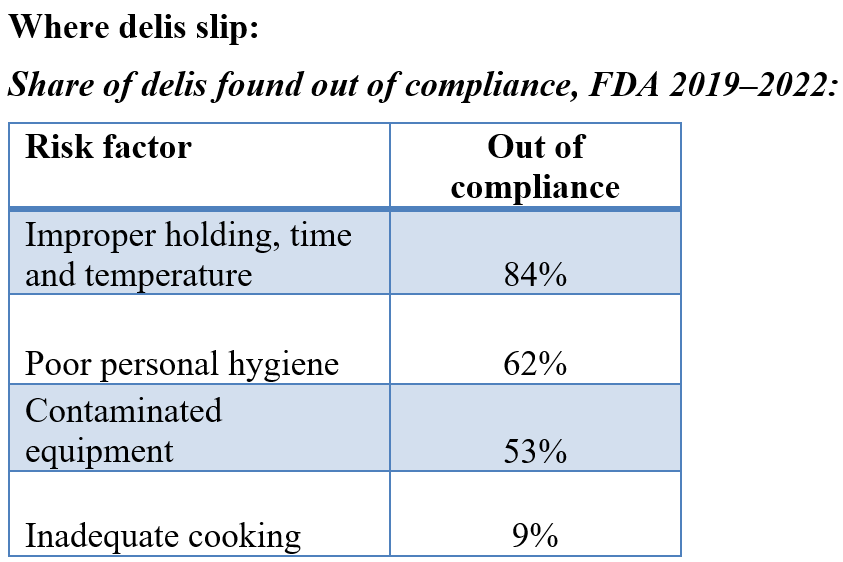
That’s why the timing of the FDA’s deli risk-factor report, released just a day before the new Code, matters. Researchers observed 438 randomly selected retail delis from 2019–2022 (full technical report, PDF). The results, summarized by FoodSafetyNews, are a reality check.

The least common problem was cooking, the part consumers understand best. The biggest problems were the boring basics: holding food at the right temperature and washing hands.

Formalizing employee health standards

It’s 7 p.m., the dining room is full, and the fry cook texts: “I’ve been throwing up.” The manager does instant math: send him home and the line collapses, or keep him and hope. The pressure to say “can you push through tonight?” is enormous.

A written illness policy changes that math. The decision about who stays home gets made on a calm Tuesday, not in the weeds on Saturday.

That’s why the 2026 Code’s written-policy requirement is fundamentally a food-safety rule, not an HR nicety. CDC has found 1 in 5 food workers surveyed worked at least one shift with vomiting or diarrhea in the prior year.

This is also where leadership shows up in the data. Researcher Craig Hedberg, studying restaurants with and without outbreaks, found “we were much less likely to find a certified kitchen manager in a restaurant that experienced an outbreak.” CDC’s own review reached the same conclusion: restaurants with kitchen managers certified in food safety were less likely to have outbreaks.

For allergies, the same systems logic applies. The Code clarifies allergen cross-contact because the most dangerous ingredient can be the one that wasn’t supposed to be there, left behind on a utensil or surface. For a severely allergic child, changing gloves, washing equipment, and separating ingredients matters as much as reading the recipe.

From rules to systems

Perhaps the most important finding from the deli study had nothing to do with a pathogen. Delis with a Certified Food Protection Manager as the person in charge had significantly better food-safety management scores — and having a well-developed FSMS was the strongest predictor that risk factors would be minimized.

An FDA-funded review put it bluntly: “an inadequate food safety management system was the strongest predictor of data items being out of compliance… the average number of out of compliance items is greatly reduced when there is a well-developed FSMS.”

A kitchen without that system is like an orchestra without a conductor, fifteen talented people playing from different sheet music on a Friday night. The 2026 Code’s big bet is making the conductor role mandatory: a written system, a trained person in charge, and verification that it actually runs during every shift.

Keeping up with how we eat

Even the smaller updates fit this defensive posture. Freeze-drying guidance exists because restaurants are experimenting with the technique– removing water slows many microbes but doesn’t guarantee every pathogen is gone, so the Code asks the old questions of a new technology: did the process work, was the food handled safely beforehand, how do you verify?

Specialty mushrooms get a mention because the restaurant pantry looks different than it did a generation ago. Food donation provisions exist because clear rules for storage and handling make restaurants more comfortable donating edible food, not less.

You shouldn’t need to interrogate your server about refrigeration logs before ordering dinner. That’s the point. The meal you see sits on top of a safety system you don’t: decades of basics that still work, plus a government playbook that updates before our eating habits outrun it. The deli data says our biggest opportunities are still surprisingly basic – temperature, handwashing, sick-leave policies, training, and putting someone in charge of the system.


FFA Spotlight: Championing Farmers’ Mental Health

When people think of hurricanes, they typically think of coastal communities, not tiny farming towns nestled in the Appalachian Mountains, hundreds of miles from the coast.

Among the communities impacted by Hurricane Helene in 2024, one of the hardest hit was Erwin in Unicoi County, Tennessee.

The Nolichucky River flooded the town of Erwin and the surrounding area. Several homes were completely destroyed, and more were damaged. The hospital was completely destroyed. Farmland that was once lush fields was wiped away to bare bedrock within hours.

Despite the devastation, Erwin FFA members felt called to embody the National FFA motto, “living to serve,” by helping their community.

Attention teachers and Advisors! Are you attending the FFA Conference in Indianapolis?

Visit Dirt to Dinner in Booth #963 to nominate your FFA students!

The chapter volunteered and assisted in community service projects that helped disaster relief efforts, including serving hot meals to people in need, clearing up debris and lending a hand on small farms that were damaged. Not only did Erwin FFA members contribute to their community, but they also showed up to support each other.

One of these members is Abigail Petterson, a former Erwin FFA member and the current East Tennessee Regional Reporter. After completing service projects in her community with her fellow FFA members, Abigail took her personal efforts one step further.

Abigail conducted an agriscience fair project, surveying 50 farmers in East Tennessee, asking about the state of their mental health before and after the hurricane, as well as whether they were aware of resources available to them.

Her findings concluded that more than half of the farmers surveyed reported that the storm had negatively affected their mental health, and many had little awareness of resources available to help.

Since then, Abigail has worked to address common misconceptions about mental health and how to better support farmers after a natural disaster.

As the East Tennessee Regional Reporter, she manages the East Tennessee FFA Instagram account, where she posts content on mental health awareness whenever possible.

Through her role, Abigail has also had the opportunity to publish articles, go to conferences and host workshops. You can read her article on Hurricane Helene and view other pictures from her efforts here.

In addition to her research on farmers’ mental health and her role as East Tennessee Regional Reporter, Abigail has competed in nursery and landscape competitions for two years.

The competitions are broken down into multiple parts, including plant identification, planting and propagation, general knowledge and the math behind a landscape plan.

For Abigail, the skills overlap more than you might expect. Whether it’s a landscape plan or a community recovering from disaster, both take patience, planning and steady care to help something (or some people) grow back stronger.

FFA is the top school-based youth leadership development organization in the country, with over one million members. As one of these members, Abigail has had the opportunity to pursue many different passions through the organization, and her mental health advocacy and research have inspired her to seek a future career in her hometown.

Abigail is now a freshman at the University of Tennessee, Knoxville. Post-grad, she hopes to become a rural mental health counselor, providing counseling and therapy services to communities with limited access to mental health resources.

How Can Biotech Improve our Food System?

Researchers found that genetically engineered corn and soybeans were associated not only with higher average yields, but also with less year-to-year yield volatility and some protection against adverse climate effects. The technology also appeared to slow some of the northward movement in U.S. crop production associated with changing climate conditions.

That matters because crop resilience is about much more than getting through one difficult growing season. A more dependable harvest can help farmers plan with greater confidence, reduce catastrophic losses, stabilize income, and create more room to reinvest in things like better irrigation, precision agriculture, soil testing, improved machinery, and healthier soils (i.e., a healthier world).

GMO crops, How Can Biotech Improve our Food System?

In other words, biotechnology may be doing more than helping farmers produce bigger harvests. It may be helping make agriculture more dependable. And when you are feeding millions of people, dependability matters.

Some genetically engineered traits can also reduce certain insecticide applications, support reduced-tillage systems, and help farmers produce more food on existing farmland.

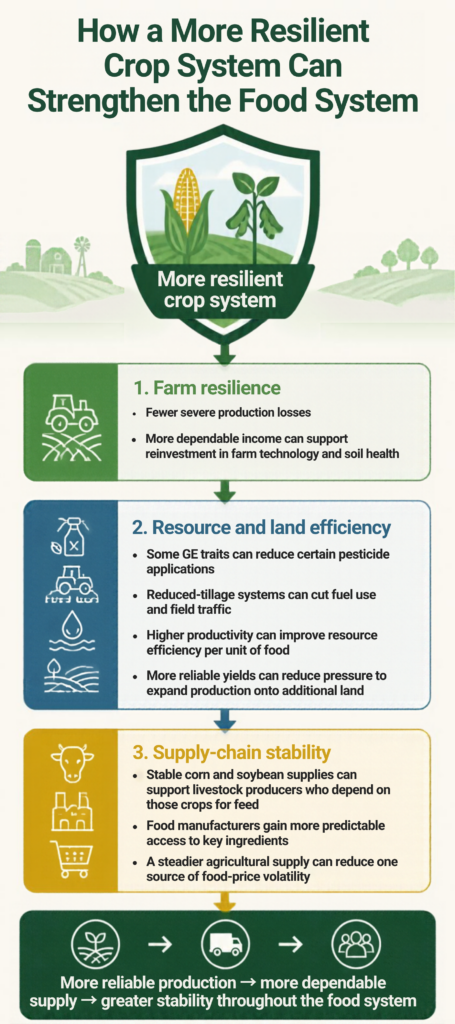
Taken together, these benefits can create a larger ripple effect: More resilient crops, more stable farms, more efficient use of resources, greener practices and a more reliable food supply.

We’ve Been Talking About GMOs for a Long Time

At Dirt to Dinner, this is hardly our first conversation about crop biotechnology.

We have explained how GMOs work, explored their potential to improve yields and reduce agricultural inputs in our 5 Benefits of GMOs, and broken down the often-confusing difference between GMOs and CRISPR. More recently, the story has moved beyond traditional genetically engineered crops.

We looked at how biotechnology could make everyday foods more nutritious in Engineering Nutrition: The Crops Changing Public Health, including lettuce with more beta-carotene and vitamin C and tomatoes designed to provide more vitamin D. And earlier this year, we explored whether gene-editing technology could rescue crops facing disease, drought, heat, food-safety challenges, and other threats.

Those stories largely asked a forward-looking question: What might biotechnology allow us to do?

This new research asks something different:

After decades of farmers actually using genetically engineered seeds, what can we now see happened in the fields?

A 40-Year Experiment Hidden in America’s Farmland

Imagine trying to test whether a technology helps agriculture cope with changing weather. Ideally, you might plant thousands of identical farms across the country. Half would use genetically engineered seeds, half would not. You would expose them to the same heat, rainfall, insects, soil conditions, and management practices for decades, then compare the results. Of course, no such experiment exists.

Instead, researchers Caroline Yifan Dong, Chengcheng Fei, Bruce McCarl, David Zilberman, and Xingguo Wang used something much larger: America’s actual agricultural history.

Their new study in Nature Climate Change analyzed crop production, climate, land use, and genetically engineered crop adoption across the United States from 1978 through 2020. That time span matters.

Commercial adoption of genetically engineered crops accelerated in the 1990s. According to the USDA Economic Research Service, today’s major GE crops include corn, soybeans, and cotton, particularly varieties engineered for insect resistance, herbicide tolerance, or both.

That gave researchers years of agricultural data before widespread adoption and decades of experience afterward. They then asked several questions:

  • Did yields change?
  • Did they become more or less volatile?
  • Did changing temperatures and rainfall affect GE crops differently?
  • And did biotechnology influence where farmers could continue successfully growing these crops?

GMO crops, How Can Biotech Improve our Food System?

The researchers concluded that GE adoption was “broadly associated with yield benefits,” with higher yields and lower yield volatility in corn and soybeans, partial buffering of damaging climate effects, and more modest benefits in cotton. But the word volatility may be the most important part of that sentence.

Bigger Harvests Get Attention. Reliable Harvests Matter, Too.

We tend to measure agricultural progress by asking how much more we can grow. If an acre of farmland once produced 150 bushels of corn and now produces 180, the improvement is easy to see.

But imagine two farmers whose fields both average 180 bushels over several years:

  • Farmer A harvests roughly 175, 182, 178, 184, and 181 bushels – planning ahead pays off in consistent yield
  • Farmer B harvests 220 one year, then 135, 210, 145, and 190 – this farmer is riding an agricultural roller coaster 

Their averages may eventually look similar, but their businesses do not. 

Farmers have to buy seed, fertilizer, equipment, fuel, and crop-protection products months before harvest. Grain elevators need to anticipate storage. Livestock producers depend on crops to feed their animals. Food manufacturers contract for ingredients. Exporters negotiate shipments. A wildly unpredictable harvest can ripple far beyond the field where the crop was grown.

This is what makes the new study interesting. For corn and soybeans, GE adoption was associated not just with higher production, but lower year-to-year variability in production. Think of resilience as suspension on a car. Good suspension does not make the potholes disappear. It reduces how violently the car reacts when it hits them.[SL1]

Likewise, a resilient crop does not make drought, excessive heat, insects, or heavy rainfall disappear. It may simply help soften the blow. And softening the blow has consequences. A farmer who repeatedly loses large portions of a crop may have little financial flexibility beyond covering the next season’s bills. A farmer with more dependable yields has a better chance of investing in the next improvement.

On a farm, those options might include improved irrigation, precision nutrient application, drainage, newer equipment, cover crops, better storage, or technology that can make the next crop healthier and more efficient. That is why resilience can compound over time.

Resilience Can Also Mean Doing More With Less

The environmental side of this story matters, too. Not every GMO reduces every crop input, and the benefits vary by crop, trait, geography, and management system. But certain genetically engineered traits have delivered measurable efficiencies. Insect-resistant crops, for example, can reduce the need for some insecticide applications because the plant itself is protected against specific pests.

Herbicide-tolerant systems have, in some cases, helped support reduced-tillage or no-till practices. That can mean fewer tractor passes across a field. Fewer passes can mean less fuel use. Less tillage can mean less soil disturbance. And if farmers can produce more food reliably on the same acreage, there may be less pressure to compensate for poor yields by bringing additional land into production.

That last point is especially important. A farm’s environmental footprint is not just about how many pounds of fertilizer, pesticide, or fuel it uses. It is also about how much food is produced from those resources. If one acre produces more food with the same or fewer inputs, the environmental cost per bushel or pound of food can fall.

That is a much more useful way to think about efficiency. The goal is not simply “use less.” It is using resources more productively.

Here’s the Surprising Part: Most Were Not “Climate Crops”

It would be easy to assume these crops were genetically engineered specifically to survive climate change. Most were not.

The major first generation of genetically engineered crops planted across American farmland primarily offered farmers traits such as insect resistance and herbicide tolerance. Bt corn, for example, is engineered to defend itself against certain destructive insects. Herbicide-tolerant crops give farmers additional tools for controlling weeds competing with crops for sunlight, nutrients, space, and water.

Neither trait sounds like a weather technology. But a corn plant does not experience stress one problem at a time.

Picture trying to run a marathon on a very hot day. Now imagine doing it while fighting the flu and carrying a heavy backpack. Removing either of those additional burdens will not cool the weather, but it may make coping with the heat a little easier.

Plants face similar stacks of stress. During drought or excessive heat, a plant already has limited resources. Add significant weed competition or insect damage, and those resources are stretched even further.

The new research suggests that the combination of GE crop development and the farming practices surrounding it may have helped buffer some climate-related stress. That does not mean every GE trait automatically makes a plant climate-resistant. It means biotechnology may contribute to resilience even when “climate resilience” was not the original trait printed on the seed bag.

America’s Farm Map Is Moving

There was another finding that may be even harder to picture from the grocery aisle: where America grows crops is changing.

Farmers do not simply decide where corn, cotton, or soybeans should grow based on tradition. Agricultural geography is influenced by growing-season temperatures, rainfall, frost dates, soils, pests, water availability, and economics. When those conditions change, crop production can move.

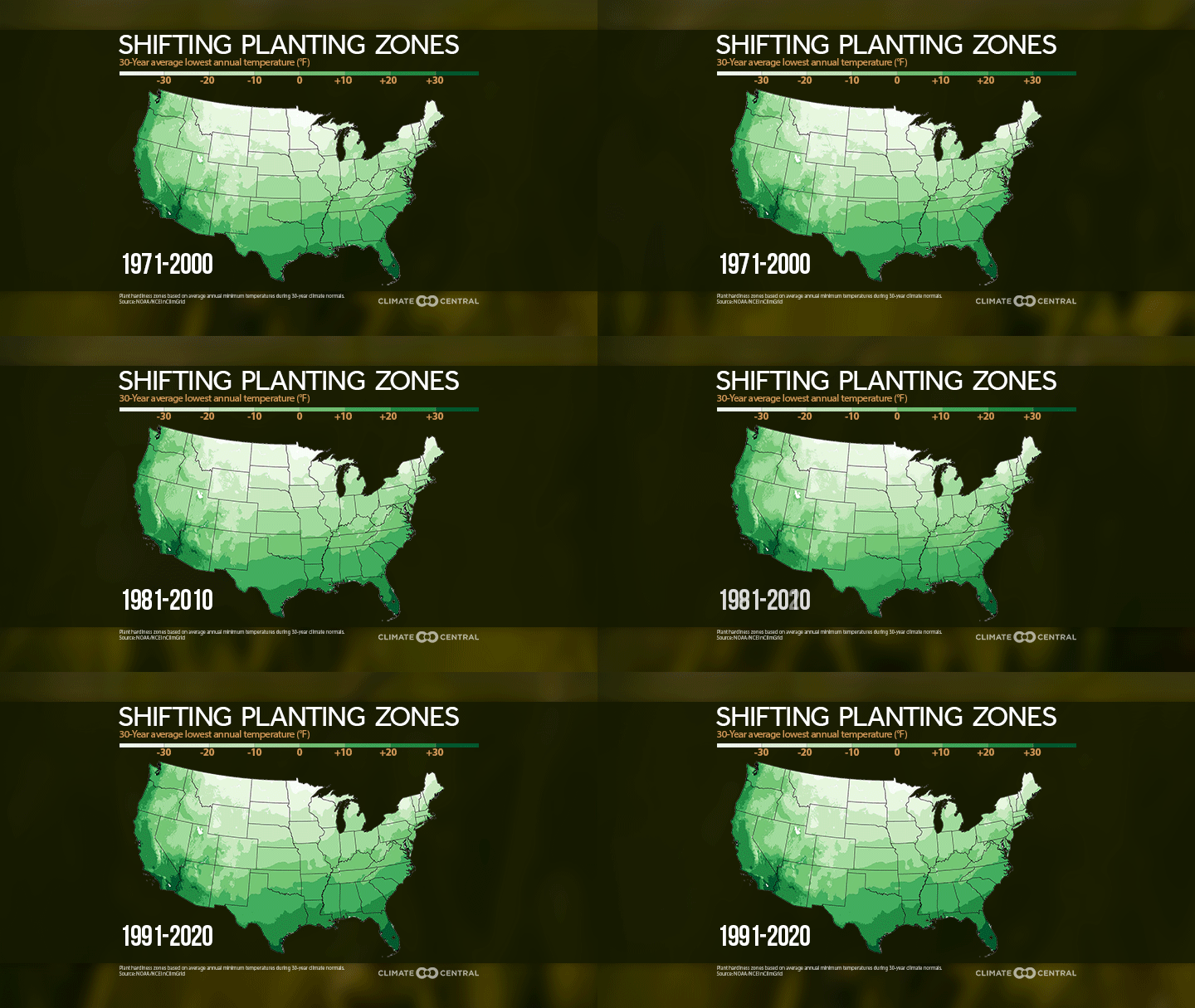
Over the study period, researchers observed northward shifts in cultivation. Previous research has shown that climate is one contributor to these geographic changes. But when the researchers modeled what U.S. agriculture might have looked like without genetically engineered crop adoption, they found something intriguing: GE adoption appeared to dampen some of that climate-driven northward movement.

GMO crops, How Can Biotech Improve our Food System?

In plain English, biotechnology may have helped some farmers maintain production in regions where changing conditions otherwise would have placed greater pressure on cultivation to move elsewhere.

That does not mean the Corn Belt is staying frozen on a map forever. It suggests technology may give farmers more room to adapt where they already are. And there are consequences when agriculture has to move. New crop acreage can require different infrastructure, transportation networks, storage, processing capacity, irrigation, and potentially conversion of other land to agricultural production. Keeping existing productive farmland productive can therefore matter well beyond an individual farm.

Why Does This Matter to Someone Buying Groceries?

Most of us will never choose corn seed or worry about soybean yields. We choose tortilla chips, cereal, chicken breasts, cooking oil, milk, eggs, and hundreds of other foods connected directly or indirectly to American agriculture. Corn and soybeans are major livestock feed crops, so what happens in those fields does not necessarily stay in the produce or grain aisle.

GMO crops, How Can Biotech Improve our Food System?

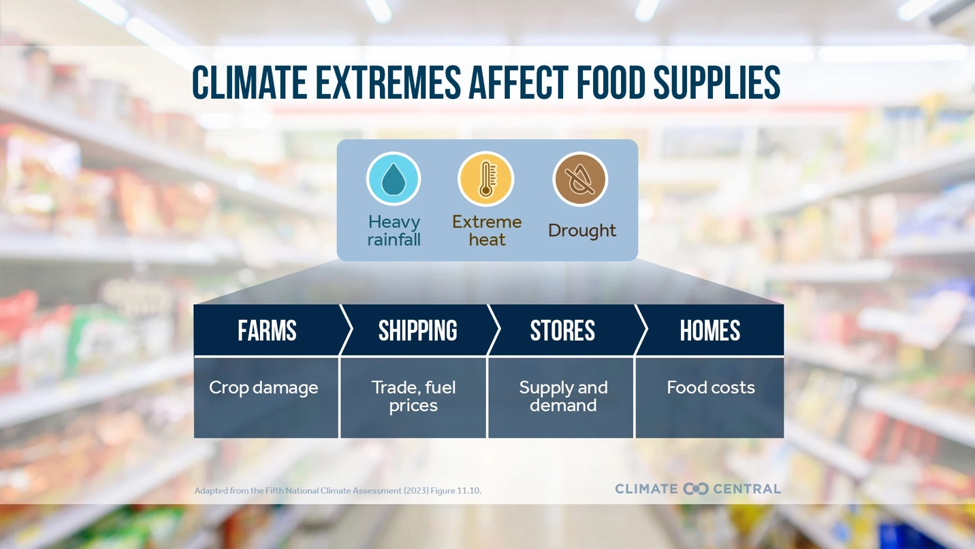
When harvests become less reliable, the effects can travel through storage facilities, feed markets, transportation networks, food manufacturers, livestock farms, and eventually grocery supply chains.

GMO crops, How Can Biotech Improve our Food System?None of this means GM crops guarantee cheaper groceries. Food prices are influenced by labor, transportation, energy, weather, trade, processing, packaging, and global demand.But a food system built on more reliable harvests starts from a stronger position than one built on unpredictable ones. For consumers, “yield stability” sounds like agricultural jargon.
At its simplest, it means something much more familiar:

Will there still be enough to go around after a difficult growing season? And the evidence suggests the next chapter of the GMO conversation may be less about producing the biggest harvest possible under perfect conditions and more about something arguably just as important: producing food reliably when conditions are anything but perfect.

Genetically engineered crops have long been evaluated for their safety, productivity, environmental impact, and ability to protect plants from insects and weeds. New long-term research adds another consideration: stability. Across four decades of U.S. agriculture, GE adoption was associated with higher yields and lower yield volatility in corn and soybeans, some buffering against adverse climate effects, and less climate-driven movement of crop production northward. Those benefits can extend beyond the plant itself.

More reliable crops can support more stable farm income, encourage reinvestment in technology and soil health, improve resource efficiency, reduce certain inputs in some systems, lessen pressure on additional farmland, and strengthen the reliability of the broader food supply. Biotechnology will not solve every agricultural challenge.

The Sugar-Free Chocolate Puzzle

I picked up my favorite sugar-free dark chocolate from Wilbur Chocolate. It was dark chocolate bark with almonds. As always, I am happy to indulge in my favorite treat without spiking my glucose.  I wondered why there isn’t more sugar free chocolate? Is it the alternative sweeteners? Is it the taste?  What about the texture?

We all know the detriments of sugar. The CDC states that Americans eat over 70 grams of sugar a day versus the recommended amount of approximately from the American Heart Association of 36 grams per day for men and 25 grams for women. However, GLP-1, consumers are becoming a bit more aware of what they are eating.

What Consumers Actually Say

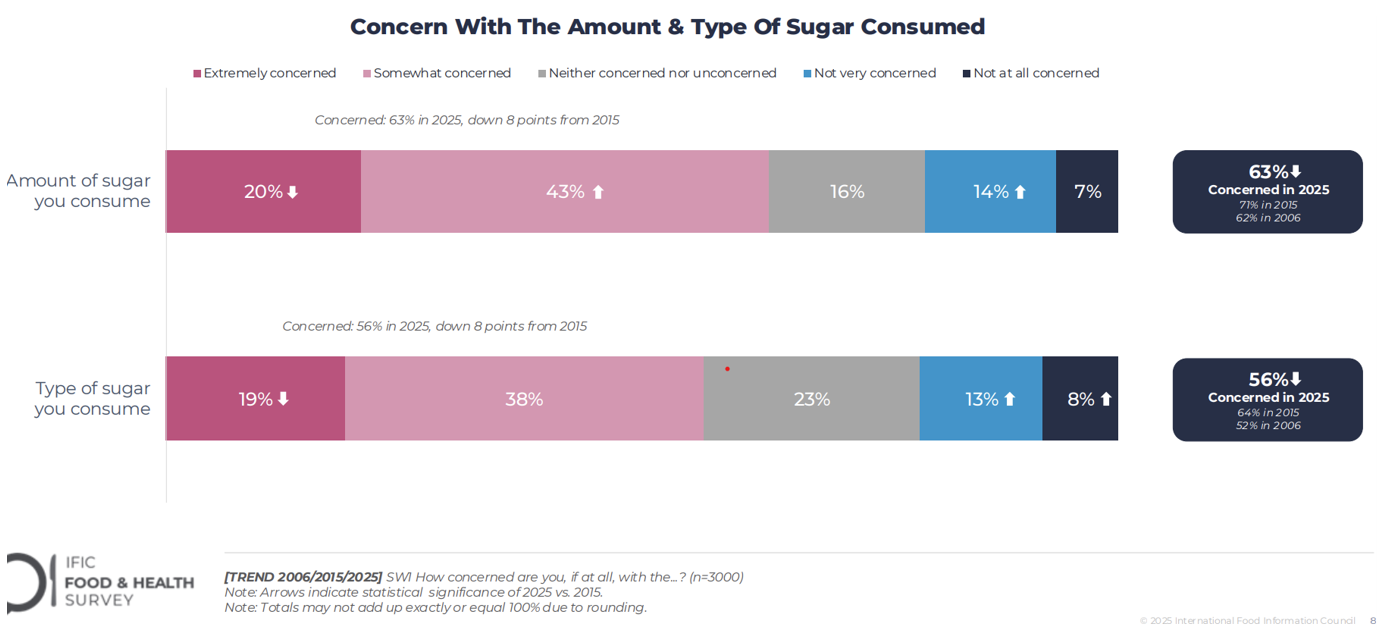
The demand signal is unambiguous. In the 2025 IFIC Food & Health Survey, which polled 3,000 Americans, 75% reported trying to limit or avoid sugar — 61% limiting, 14% avoiding entirely. Among that group, 63% were specifically targeting added sugars.

Mintel’s proprietary survey said that 41% of US consumers agree that confusion about how much sugar they are consuming makes them worried about their health.  As a result, 52% are either currently purchasing sugar free chocolate or are interested in trying it.

But there is also a permission structure worth noting. Many Americans eat healthy 80% of the time, with the remaining 20% being more flexible. For instance, during celebrations and special occasions, all guilt goes out the window. Chocolate lives in this 20%, as well: holidays, celebrations, birthdays. For sugar-free chocolate to be part of the party, it must compete not only on taste, but against a cultural allowance for the real thing.

How Fast Is the Market Actually Growing?

This is where we would urge some healthy skepticism about the numbers you will see quoted.

Published estimates of the global sugar-free chocolate market vary by more than a factor of two. One firm values it at $1.27 billion in 2024, growing at about 5.5% annually. Another places it above $3.1 billion in 2025 with a 5.6% growth rate. Estimates for related segments run higher still — 7.5% for sugar-free candy and chocolate combined, 8.5% for sugar-free dark chocolate specifically.  In the U.S., retail sales for sugar free is $375 million.

Mintel predicts sugar free chocolate growth is about 1.1% versus chocolate confectionary at 4.7% per year.

The Cocoa Complication

None of this is happening in a stable cost environment. Cocoa futures hit a record near $12,900 per metric ton in December 2024 after drought, erratic rainfall, and disease hammered West African harvests. By September 2026 prices had fallen to roughly $5,598 — more than 55% below the prior year — as production recovered and the market moved into surplus.

But relief has not reached the shelf. Manufacturers hedge cocoa exposure 12 to 24 months out, so the costs locked in during the 2024 spike were still flowing through budgets well into 2026, with U.S. chocolate prices tracking about 14% above year-earlier levels even as futures collapsed. European cocoa grindings fell 7.8% year over year in the first quarter of 2026, the lowest quarterly total in more than a decade.

For sugar-free products, this compounds an existing problem. Barry Callebaut’s R&D leadership has noted that polyols such as erythritol and maltitol cost more than cane sugar, meaning any sugar reformulation typically raises raw material costs. A sugar-free bar carries a premium on both its cocoa and its sweetener system.

How is Chocolate Made?

It all begins with the cacao tree, 70% of which is grown in West Africa. The rest are from S. America and parts of Asia. Each tree grows pods which contain about 40 seeds in every pod. The seeds are the cocoa beans which give us the chocolate we love.

Once the seeds are dried and separated from the shells, these ‘nibs’ are grown into cocoa liquor. Finally, the liquor is pressed under very high pressure and yields cocoa powder and cocoa butter.

The ingredients of the chocolate you eat depends on the type of chocolate: dark, milk, and white. Dark is cocoa, cocoa butter, and sugar.  Add some milk powder and you have milk chocolate.  Skip the cocoa powder and you make white chocolate. But what makes chocolate so great is sugar.

Sugar Does More Than Sweeten

When you bite into a chocolate dessert or bar, you anticipate a certain sweetness, texture, and flavor. If you expect that – and get something else – inevitably you are disappointed. Generally, sucrose makes up close to half of a conventional chocolate bar’s composition.

Sugar in chocolate plays three roles at once: a sweetener, a bulking agent, and modulator of mouthfeel and flow behavior. Pull it out and you are not removing a flavor and mouth feel, you are removing structure.

This is different from, say, a beverage. Take the sugar out of the soda and you can replace it with any sweetener and the liquid will remain the same. Take the sugar out of a chocolate bar and you have to physically replace that mass with something that behaves similarly when the chocolate melts on your tongue at body temperature.

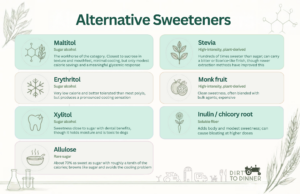
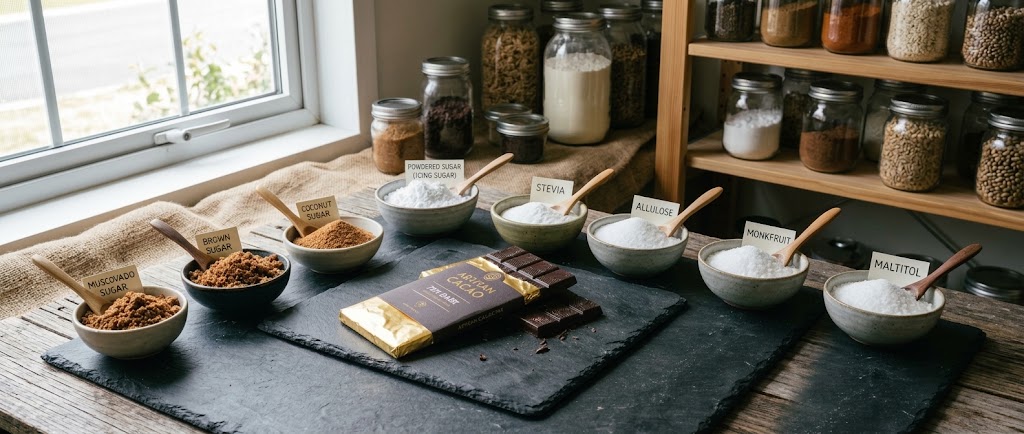
Formulators generally solve this in three layers. High-intensity sweeteners such as stevia and monk fruit deliver sweetness but contribute essentially no bulk. Bulk sweeteners such as maltitol, erythritol, and allulose rebuild the mass and particle structure.

Fibers such as inulin and chicory root improve mouthfeel and can soften the off-notes of the high-intensity sweeteners. Almost no sugar-free bar on the shelf uses just one ingredient, because no single ingredient does all three jobs.

Removing sugar from chocolate is not subtraction. It is reconstruction — and every substitute rebuilds a different part of what was lost.

A Field Guide to the Sweeteners

The names on the back of the wrapper fall into recognizable families, each with a distinct profile:

Maltitol’s economics illustrate the trade-off well. It delivers the mouthfeel manufacturers want, but at roughly 2.4 calories per gram, swapping it in yields a calorie reduction of only about 13% compared with sucrose.

Erythritol saves far more — but push it high enough to qualify for a “light” claim and the bar develops an unmistakable cool, almost minty sensation on the tongue, a consequence of its strongly negative heat of solution.

Allulose is the ingredient generating the most industry attention right now, precisely because it sidesteps several of these problems. It browns and bulks more like sugar without the cooling effect that complicates maltitol and erythritol formulations.  However, there is litigation as to whether it really is sugar or not. The FDA says it is not and it has zero glycemic impact, yet plaintiffs are suggesting that the 0.4 calories per gram counts as ‘sugar’ (compared to sugar’s 4 calories per gram).


Tagatose is another great solution for sugar free. Considered a ‘rare sugar’ it comes from nature, such as apples, pineapples and the sap of a tree related to the cacao plant. It acts like sugar: it tastes sweet, browns, bulks, lowers the freezing point for frozen desserts, binds water, and has 60% fewer calories.  Plus it has probiotic properties.


The Taste Problem Is Getting Smaller, Not Gone

The honest assessment is that sugar-free chocolate is meaningfully better than it was a decade ago and still detectably different from the real thing.

Cooling is the most common giveaway. When I bite into my favorite dark chocolate bark with almonds, there is definitely a cooling flavor. In addition, have you ever opened a chocolate bar and it is partly white?

While it is safe, it is called bloom. Bloom resistance and tempering behavior are the manufacturer’s headache — polyol-based bars can be harder to temper and more prone to developing that dull white surface film in storage.

Stevia’s bitter finish has improved substantially with better extraction and with blends that pair steviol glycosides with monk fruit compounds, but sensory panels can still pick it out.

Research on milk chocolate made with maltitol and xylitol found that high-maltitol formulations came close to conventional chocolate on moisture, particle size, and sensory scores — but that higher xylitol ratios changed viscosity and flow behavior noticeably. Getting it right is a matter of ratios, and small changes matter.

Then there is digestion. Sugar alcohols are incompletely absorbed in the small intestine, which is what makes them low-calorie and also what produces the bloating, gas, and laxative effects that the fine print warns about. This is dose-dependent and highly individual. One square is rarely a problem. Half a bar in one sitting, for many people, is.

The Health Question Is Not Settled

Erythritol deserves a specific mention because it has been the subject of debate and internet rumor.

A 2023 study in Nature Medicine from Cleveland Clinic researchers found that higher blood levels of erythritol were associated with increased cardiovascular event risk, and showed in mechanistic work that erythritol enhanced platelet reactivity and clot formation. Subsequent intervention work in healthy volunteers reported the same platelet effect, which glucose did not produce.

The counterargument is worth understanding. Erythritol is produced naturally in the human body through normal glucose metabolism, which means elevated blood levels may partly reflect underlying metabolic dysfunction rather than dietary intake — a classic confounding problem. And findings have been inconsistent across populations. The ARIC study of older adults found associations with heart failure hospitalizations and mortality, but not with the full range of outcomes reported elsewhere.

Erythritol currently retains GRAS status with the FDA. The researchers behind the cardiovascular work have argued that status deserves reevaluation. That is where the science sits: a genuine open question, not a settled verdict in either direction.

Labeling has its own gray area. The FDA has exercised enforcement discretion allowing allulose to be excluded from total and added sugars on the Nutrition Facts panel, while still counting toward total carbohydrates at 0.4 calories per gram. That is guidance, not regulation — a distinction that matters. A federal appeals court recently revived a proposed class action against Chobani from consumers who felt a “zero sugar” claim was misleading on a product containing allulose.

And a broader point on labels: only 16% of Americans correctly identified the Dietary Guidelines recommendation to keep added sugars under 10% of daily calories. Seven percent believe the recommended limit is zero. When people do not know the target, “sugar-free” becomes an easier heuristic than it should be.

The most useful question about a sugar-free bar is not whether it is healthier than a regular one. It is whether it fits a pattern of eating you can actually sustain.

Food for Thought

Sugar-free chocolate is a legitimate innovation serving a real need, particularly for people managing blood glucose or dental health. The taste gap has narrowed considerably, and allulose in particular is solving problems that stymied earlier formulations.

But it is not a free pass. These bars still contain fat and calories, sugar alcohols can cause real digestive discomfort at ordinary serving sizes, and the long-term data on some of these ingredients remains genuinely unsettled. A sugar-free label answers one question about a food and leaves several others open.