All infographics are free to share and use for educational or editorial purposes with attribution to Dirt-to-Dinner.com.

*
Key Takeaways:
Picture the corner store on your block or the one you pass on the way to work. The wall of chips. The soda cooler glowing like a jukebox. The candy rack at kid-eye level by the register. Now picture that same store with fresh apples by the door, milk in the cooler, and rotisserie chicken where the jerky used to be. That is the bet the USDA is making this fall.
Every SNAP-authorized retailer has always had to stock “staple foods” but the old bar was low: just three varieties in each of four categories (dairy, fruits and vegetables, grains, and protein). And the definition of a “variety” was loose enough that snack foods could do the heavy lifting. Beef jerky counted as protein. Cheese dip counted as dairy. A granola bar could stand in for grains.
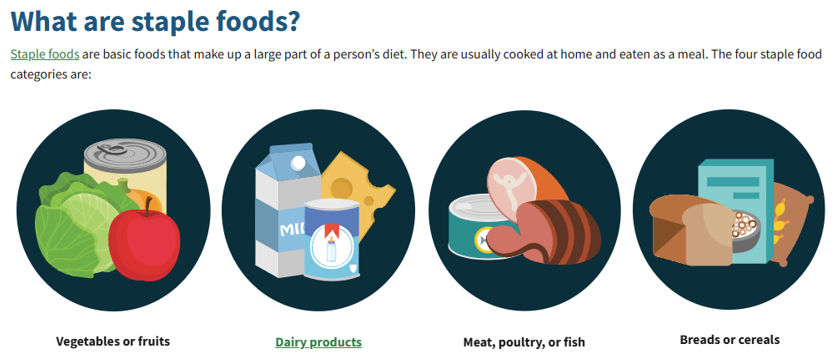
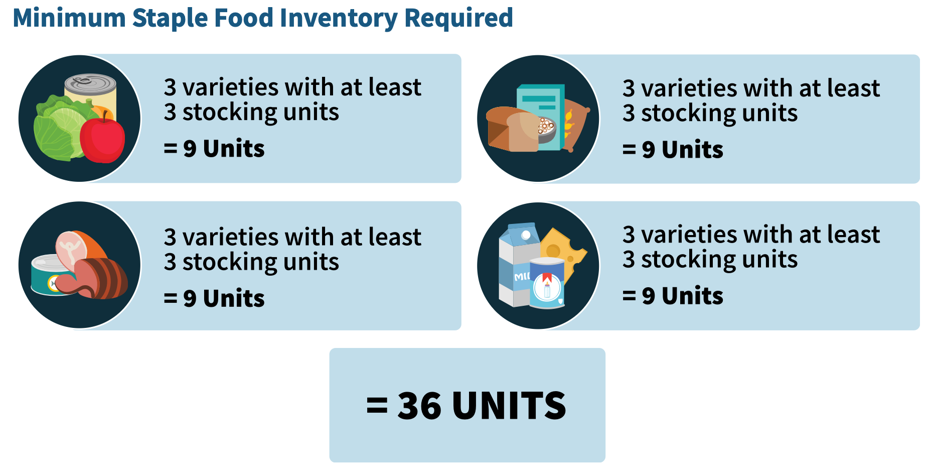
USDA’s final rule on updated staple food stocking standards, published May 8, 2026 in the Federal Register, more than doubles the previous requirement. Now, retailers must provide seven varieties in each of the four staple categories, for a minimum of 28 qualifying items.
It also requires a perishable item (think fresh produce, milk, meat) in at least three of the four categories, and it closes the snack loophole explicitly: butter, jerky, cheese dip, snack bars, and fruit spreads no longer count toward the total. The rule classifies butter and all jerky as accessory foods, and adds snack bars, cheese spreads, and fruit spreads to that list. (Shoppers can still buy them with SNAP; the rule changes what stores must stock, but not what customers can buy.)
On November 4, 2026, roughly a quarter-million stores that accept SNAP benefits, the program most of us still call food stamps, were supposed to have a lot more real food on their shelves, or lose the ability to take SNAP at all. USDA put the number at nearly 266,000 retailers in its September 2025 announcement of the proposed rule.
However, enforcement of the new rule did not follow on schedule…and for understandable reasons. Hundreds of convenience stores and trade associations and a dozen senators asked USDA for a six-month delay, arguing that they have not received enough guidance on how to comply and need time to line up distributors, negotiate with suppliers, and reconfigure shelves for perishables. Without more time, thousands of stores could simply drop out of SNAP, which would reduce food access in exactly the neighborhoods the rule is trying to help.
On November 13, New York City Mayor Zohran Mamdani announced a nationwide delay of at least 90 days, after discussions with President Donald Trump and USDA Secretary Brooke Rollins. The USDA then told retailers they have until February 11, 2027 to comply. The requirements themselves have not changed, only the enforcement clock.
Now, if a store misses the new February date, the store may get withdrawn from SNAP and cannot reapply for six months.
Here is the part most people miss: this rule is not really about supermarkets.
Supermarkets already stock hundreds of varieties. It is about the small-format stores that are a huge share of the program. More than 117,000 convenience stores accept SNAP, nearly half of all authorized retailers, according to the industry’s letter to USDA. For millions of shoppers, shift workers, people in neighborhoods without a full grocery store, rural towns where the gas station is the grocery store, the corner store is the food provider.
USDA is not starting enforcement from zero, either. The agency says it has already taken action on nearly 3,200 retailers since the beginning of the Trump Administration over the current stocking standards, denying applications or disqualifying stores that fell short. The message, as HHS Secretary Robert F. Kennedy, Jr. put it in that same USDA announcement, is that “this rule puts real food back at the center of SNAP.”
Putting broccoli on the shelf and putting broccoli in the cart are two different things.
This is where the science gets humbling. Researchers have run the experiment repeatedly and the results should temper everyone’s expectations, supporters and skeptics alike.
In one of the most thorough tests, Drexel University researchers spent two years upgrading eight corner stores in East Los Angeles with produce displays, better shelving, fresh fruits and vegetables, and owner training. The result? No significant change in what nearby residents bought or ate.
“Given the financial and technical support that we were able to provide to stores, it is quite disheartening that we saw no real changes in food purchasing or diet at the community level.”
A landmark RAND study in Pittsburgh found something similar after a full-service supermarket opened in a food desert: residents reported eating fewer calories and less sugar but the changes were not related to shopping at the new store, and fruit and vegetable consumption actually declined. Access improved on paper, but behavior barely budged, as the researchers reported.
As food policy writer Marion Nestle put it: “Access, of course, is only the first step in eating healthier foods. Affordability and cultural preferences matter even more.”
Here is the proportionate read: this rule fixes a real absurdity. It was strange that a store could qualify as a SNAP retailer while counting jerky as protein and cheese dip as dairy. Requiring whole foods on the shelves of stores that take public food dollars is common sense. For the shopper who wants the apples and just could not find them, the new shelves will be a genuine improvement, once they arrive.
But stocking standards are a supply-side lever, and diets are shaped by demand: prices, habits, culture, time, and marketing. The research says access alone rarely moves the needle. If the goal is not just fuller shelves but healthier carts, the stocking rule is necessary, but not sufficient.

Key Takeaways:
I was having breakfast at the local roadside dinner last Thursday when my neighbor asked how the momentous national election results would play out for me personally.
Darn good question, I thought, as I contemplated my over-easies and hash browns. How will it affect what I write for Dirt to Dinner?
The short answer is easy: darned if I can predict.
It will be whole new ball game on Capitol Hill and in DC, that’s for sure. Entirely new leadership in the House and Senate, with a very different set of ideas and priorities. A lot of potential conflict with the other end of Pennsylvania Avenue. New committee chairs for the Agriculture Committee, and all the other congressional bodies that have a say in our food policies and programs. A decidedly different and unhappy electorate of short-fused people fed up (a food play on words there) with an exploding cost of living.
The whole process was messed up enough before the election to defy predictions of any kind.
Anybody who tells you confidently what is going to happen – especially on matters related to food and agriculture – probably has a really great time-share opportunity or you, too.
But that doesn’t mean I can’t look ahead with certain expectations. Let’s just hope enough of the members who convene January 3, 2027, for the 120th United States Congress can put aside enough of the partisan get-even politics to focus on things that the voters said really matter.
To me, voters first and foremost said they want action to address the economic squeeze facing virtually every segment of our society.
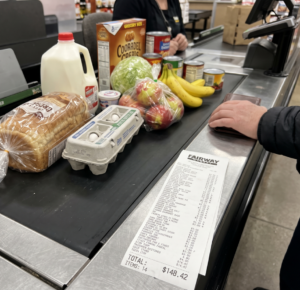 I believe elected officials are smart enough to recognize that message, and I fully expect them to couch every action they take under the guise of “helping the average person deal with the exploding cost of living.”
In real terms, that suggests we’ll see a lot of fast and highly publicized attention to dealing with the matters with greatest potential for fastest positive economic results.
I expect to see a lot of energy spent in looking at ways to unwind U.S. involvement in the Mideast conflict. Partly it will be to reduce the on-going cost of the conflict to taxpayers – about $48 billion, as I click these keys. Maybe more important, it will be the key to re-opening the flow of petroleum through the Strait of Hormuz and bringing global oil prices back down to something like pre-war levels.
That alone would have enormous positive effect in dealing with inflationary aspects of higher energy costs for everyone. Farmers stand to improve their returns when fertilizer and fuel prices drop. Consumers stand to gain – eventually – when those lower costs ripple through the food chain.
As Hamlet said, it is a consummation devoutly to be wished. Let’s just hope Congress and the Administration have some familiarity with the Bard.
But after watching six farm bills – no, maybe it’s seven? – I realize that as important as that step would be, there’s more that is likely to be done. The farm-bill debate every few years taught me how the economics of food and agriculture are interlinked with everything else economic and political. So I fully expect much of it also will be billed as “dealing with the economic troubles of the average person.”
The complication, I suspect, will be less over the objectives than the policy means needed to achieve them. In short, there’s a lot of room for continuing political haranguing. Just think about a few of the likely subjects that the Agriculture Committees – as well as a lot of other committees in both the House and Senate — will be asked to address.

Expect animated debate on this one. Do we take a less aggressive approach to the tariff issue – or somehow admit that they have been a contributor to the price increase facing at least some segments of our economy?
For example, think about what happens when a congressional committee convenes to ask a simple question like “Do the economic needs of something like the auto industry outweigh the economic interest of farmers, ranchers and food consumers?” With Democrats at the controls, expect different kind of debate than we’ve seen over the past two years.
Democrats are likely to attack tariffs as inflationary. The Administration has remained firm in its belief that tariff income is an important source of federal funds – and a key bargaining tool in the President’s attempts to redirect U.S. foreign policy.
After intensive wrangling, a proposed new Farm Bill died on the vine in 2026 as the partisan wrangling continued. That debate will return. But with Democrats in charge, expect a slightly different emphasis and framing of the key questions.
For Democrats, the Supplemental Nutrition Assistance Program (SNAP) will likely be front and center in the debate. Should we reverse Administration efforts to cut SNAP costs and restore funding and liberalize qualification programs? Wouldn’t that help a great many of the families struggling with the rising cost of feeding a family?
The additional of many more liberally minded members of Congress will prompt more aggressive pursuit of revisions. How the Administration responds to this push to the left so far hasn’t been indicated. President Trump has shown no enthusiasm for softening his drive to make SNAP less costly and more focused on those in true need of food assistance.
Should we expand conservation and other green programs to provide quick cash help for farmers while advancing our green objectives? Do crop insurance programs need to be revisited?
Many of the progressives elected to the new Congress can be expected to try to restore various green initiatives, with the rising debate over AI data centers only adding to the fun. The Administration can be expected to defend new investment in technology rather than what the right sees as “wasteful’ spending on ineffective green programs.
Would efforts to stop or reverse consolidation in key sectors such as the protein industry – notably beef — help ranchers earn more and temper the cost of protein for hungry families?
A more liberal Congress is much more likely to embrace the calls for some form of action to stop further consolidation of key sectors, notably in the food sector. Beef almost certainly will be a prime target for attention, with hearings that give ample time to the point of view of industry critics. Having many new members of Congress who lack extensive experience in the complex world of food policy may make the ride ever bumpier for conservatives who favor a more sober assessment of how best to preserve food-sector competitiveness.
The political problem with all these matters, of course, is the cold hard reality that none will have an immediate major effect on what consumers have to fork over (hah hah… fork over… get it?) at the grocery store. It will take time for all this to work its way through a big, complex food chain in which decisions are required today for things that are delivered or hit the shelves weeks or months from now.
That’s just a quick final cup-of-coffee reflection on what might happen in 2027 between our new Congress and the Administration. In the coming weeks, I expect to see a lot more put on the table for attention, all in the name of helping the consumer with the cost of living. And I fully expect the political spin-doctors working overtime to explain why any particular proposed action is the best and maybe only possible way of dealing with the concerns voters so eloquently expressed on November 3.

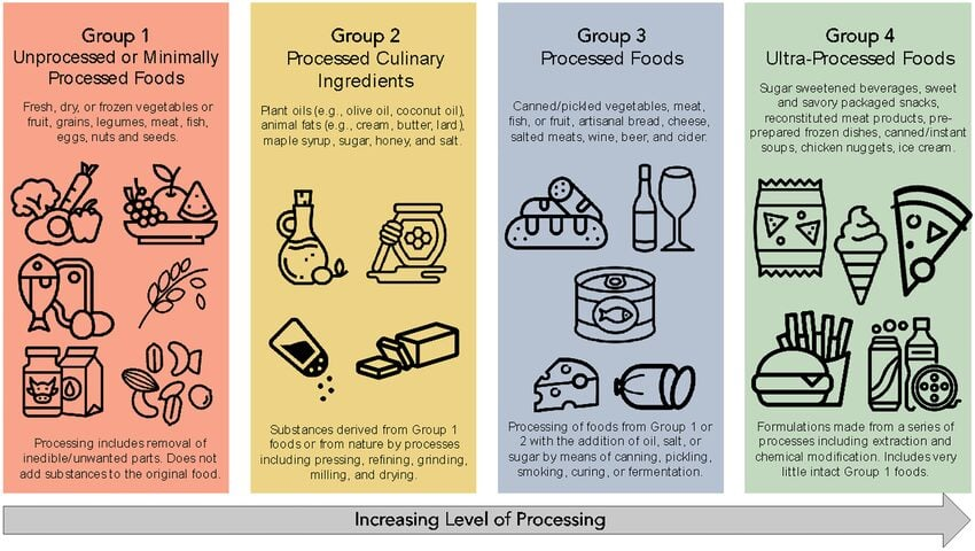
In my kitchen right now, there is a loaf of bread, a box of crackers my kids demolish after school, and a bag of frozen berries for smoothies. Under the definition most researchers use, the bread and the crackers count as “ultra-processed.” The berries don’t. What’s surprising is that sugary products, like sodas and candy bars, are lumped into the same category as my whole-grain bread and flax crackers.
If you’re wondering about the credentials for this strange category, you’re asking the right question. The federal government is about to define parameters for what constitutes “ultra-processed foods”, and when it does, the fine print will matter more than the headline.
Here’s the timeline. In July 2025, the FDA and USDA put out a joint call for data, a formal Request for Information asking researchers, companies, and the public to help build a “uniform definition” of ultra-processed foods. The idea, the agencies said, was consistency: if everyone means the same thing by “ultra-processed,” research can actually be compared and policy can be built on it. More than 5,000 comments came in by the time the window closed on October 23, 2025.
Then, on August 10, 2026, HHS and USDA announced they’d sent a proposed definition to the White House budget office, the Office of Management and Budget (OMB), for final review. As of October 13, the text still hasn’t been released. OMB’s public calendar shows a string of meetings on the “White Paper: Proposed Definition of Ultra-Processed Food” running through September and into October 2026, some of the last formal chances to get data and perspective in front of decision-makers before it publishes.
What’s new: This is the first time the federal government has tried to put its own pin in what “ultra-processed” means.
What’s established: We’ve been arguing about the concept for more than 15 years without one.
As UNC food-policy researcher Lindsey Smith Taillie put it: “You have to know what it is that you’re intervening on.” A definition is the precondition for everything downstream, from school-meal rules to label warnings.
The system most researchers use today to determine degree of food processing is called NOVA. It was created by Brazilian researchers in 2009 and sorts food not by nutrients, but by how much it’s been altered. In NOVA’s world, “ultra-processed” roughly means products made with ingredients you’d never find in a home kitchen: certain preservatives, artificial flavors, highly refined sweeteners, and industrial formulations. It does not consider the nutritional content of the food, simply the ingredients.
NOVA was a breakthrough, and it also has a well-known flaw: it’s a very big category. As one recent analysis put it, it lumps a sugary soda in with fortified whole-grain bread, even though those foods aren’t nutritionally alike. Researchers have struggled to classify the same foods the same way twice, and a 2025 review found six different classification systems, each with its own criteria.
Dozens of observational studies link high ultra-processed food consumption to obesity, cardiovascular disease, and diabetes, but researchers still haven’t pinned down which ingredients, additives, or processing methods actually drive those associations, or at what exposure levels.
My favorite illustration of where the science stands comes from Kevin Hall, a senior investigator at the National Institutes of Health. Hall thought the whole ultra-processed concept was, in his words, “nonsense” and “anti-science.” He said so publicly in a debate with food writer Marion Nestle. So he ran the experiment to prove it.
Hall housed 20 adults at the NIH Clinical Center for four weeks. For the first two weeks, the subjects ate a diet of “ultra-processed” foods (using the NOVA definition), then they switched to a diet of unprocessed foods for the last two weeks. The diets were designed to have similar amounts of calories and key nutrients, and participants were told to eat as much as they wanted.
The result embarrassed the hypothesis: people ate more and gained weight on the ultra-processed menu. “This is the first study to demonstrate causality,” Hall said, “that ultra-processed foods cause people to eat too many calories and gain weight.”
Hall’s trial is the strongest evidence in the field. It’s also one small, short study. It tells us the effect is real without telling us exactly what causes it, which is precisely why the definition’s fine print matters so much. That’s the gap a federal definition is supposed to help close. HHS has described the goal as creating “a stronger foundation for future nutrition research.” Think of it as agreeing on the ruler before arguing about the measurement.
This is the part most coverage skips, and it’s the most important. The agencies have been clear: this is coming as a white paper, not a regulation. A white paper is the government thinking out loud on paper. It has no legal force. It doesn’t pull anything off shelves, change a label, or ban an ingredient.
Here’s an analogy: a white paper is a dictionary, and a rule is a speed limit. A dictionary doesn’t give you a ticket. But once everyone agrees on what a word means, it’s a lot easier to write the speed-limit sign.
And dictionaries get cited. As legal analysts at Greenberg Traurig noted this month, calling it research-focused “does not determine whether or how it may be used later in policymaking, regulatory activity, or litigation.” Once a federal definition exists, anyone can point to it: a state legislature writing a school-meals bill, a retailer setting procurement standards, a plaintiff’s attorney building a case. Whether it ever becomes enforceable is a separate decision the administration hasn’t made yet. But the definition becomes the benchmark everything else references.
That’s why the OMB meetings matter. They’re one of the last formal windows for input before the text locks.
The entire fight comes down to what the definition keys on. Legal analysis describes three possible dials (processing methods, ingredients, nutrients, or some combination), and where the agencies set each one determines which foods land inside the category.
Does the definition care how the food was made? Extrusion, hydrogenation, industrial formulations you couldn’t replicate at home? This is NOVA’s home turf.
Does it flag what’s in it: specific additives, flavorings, colorings, preservatives? This is the most concrete dial, and the one industry watches closest, because an ingredient list is something you can reformulate around.
Does it weigh the food nutritionally? Added sugars, sodium, saturated fat? This dial looks the most like our existing nutrition labels, and it’s where a UPF definition could overlap, or collide, with everything from front-of-package labeling to dietary guidelines.
If you turn all three dials to the strictest setting, almost all items in grocery stores count as “ultra-processed”. And if you loosen up the dials, significantly fewer items qualify. The definition’s authors have to find the setting that’s scientifically defensible, and that’s the hard part, because the science hasn’t settled which dial matters most for health.
Washington isn’t waiting in a vacuum. California passed a framework and directed rulemaking around a definition of UPFs. In the Senate, the Childhood Diabetes Reduction Act was introduced in August, and the Food Labeling Modernization Act was introduced in July and referred to committee. Neither uses the same criteria as the others. Add in state bills, enforcement activity, and private lawsuits, and you have at least three definitions that don’t agree with each other.
Industry, unsurprisingly, has opinions. The Consumer Brands Association, which represents companies like PepsiCo, Nestle, and Kraft Heinz, has cautioned that “any so-called definition that captures 80% of the nation’s food supply while picking winners and losers is fundamentally flawed,” in the words of spokesperson Rhonda Bentz. Bloomberg reported that CEOs and trade groups lobbied the White House to slow the white paper’s release, expressing concern that the research is not yet robust enough to inform policy, while a definition would increase costs and litigation.
Food-law attorney Alan Sachs told Food Ingredient’s Global Insights that because this is a white paper and not a regulation, the administration isn’t obligated to publish it by any date, or at all, and it could still be modified while under review.
Public-health groups are pushing the other way. “A federal definition would represent an important step toward strengthening the science that informs future nutrition policies and consumer choices. It is time to take that step,” said Dr. Mariell Jessup of the American Heart Association, one of the few public-health groups granted an OMB meeting so far.
Both sides understand the same thing: the dictionary gets written once, and then everybody has to use it.
What’s key here for us as consumers is that the definition won’t tell you what’s healthy. It will tell you what counts, and then the arguing about what to do with the count begins. You’ll still need to remember that everything is better in moderation.
And you will still need to remember to include five to seven servings of fruits and vegetables, eat 25-30 grams of fiber, eat a minimum of 0.85 grams per pound of ideal body weight, and healthy fats.
Nothing in your cart needs to change today. I pack my five-year-old’s lunch most mornings, and I’ll pack it the same way next week. This definition won’t make any food illegal, and it won’t, by itself, change a single label or my understanding of proper balance nutrition.
But here’s the proportionate take: definitions are infrastructure.
A UPF definition is the shared language that may let researchers compare studies, could allow SNAP and school-meal programs to write rules that mean the same thing in every state, and may let labeling debates argue about policy instead of arguing about the dictionary.
What’s new is that the federal government is finally writing that dictionary entry. What’s established is that the science underneath it is still catching up. We know that observational studies have shown dietary patterns high in ultra-processed foods may be associated with real health risks, but we don’t yet know precisely which dials to turn.
Watch two things when the text drops: which of the three dials — processing, ingredients, nutrients — does the most work, and who cites it first. The first tells you how scientific the definition is trying to be. The second tells you how political it’s about to become.