The Sugar-Free Chocolate Puzzle
The Dirt
Three in four Americans say they are trying to limit sugar, and the sugar-free chocolate aisle has grown to meet them. But sugar is not just a sweetener in chocolate — it is roughly half the bar by weight, and it does structural work that stevia and monk fruit cannot do on their own. Formulators are rebuilding that missing half from sugar alcohols, rare sugars, and fibers, each with its own trade-offs in taste, digestion, and cost.
Global Food
Nutrition
The Sugar-Free Chocolate Puzzle
The Dirt
Three in four Americans say they are trying to limit sugar, and the sugar-free chocolate aisle has grown to meet them. But sugar is not just a sweetener in chocolate — it is roughly half the bar by weight, and it does structural work that stevia and monk fruit cannot do on their own. Formulators are rebuilding that missing half from sugar alcohols, rare sugars, and fibers, each with its own trade-offs in taste, digestion, and cost.
I picked up my favorite sugar-free dark chocolate from Wilbur Chocolate. It was dark chocolate bark with almonds. As always, I am happy to indulge in my favorite treat without spiking my glucose. I wondered why there isn’t more sugar free chocolate? Is it the alternative sweeteners? Is it the taste? What about the texture?
We all know the detriments of sugar. The CDC states that Americans eat over 70 grams of sugar a day versus the recommended amount of approximately from the American Heart Association of 36 grams per day for men and 25 grams for women. However, GLP-1, consumers are becoming a bit more aware of what they are eating.
What Consumers Actually Say
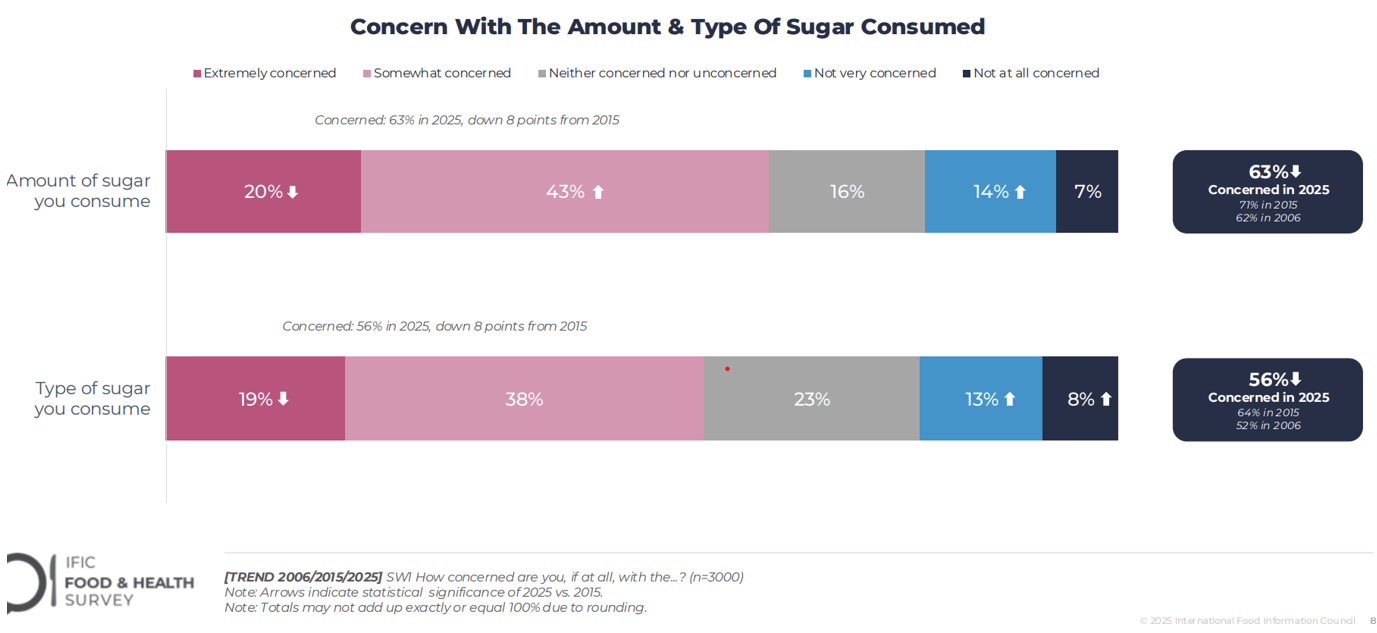
The demand signal is unambiguous. In the 2025 IFIC Food & Health Survey, which polled 3,000 Americans, 75% reported trying to limit or avoid sugar — 61% limiting, 14% avoiding entirely. Among that group, 63% were specifically targeting added sugars.
Mintel’s proprietary survey said that 41% of US consumers agree that confusion about how much sugar they are consuming makes them worried about their health. As a result, 52% are either currently purchasing sugar free chocolate or are interested in trying it.
But there is also a permission structure worth noting. Many Americans eat healthy 80% of the time, with the remaining 20% being more flexible. For instance, during celebrations and special occasions, all guilt goes out the window. Chocolate lives in this 20%, as well: holidays, celebrations, birthdays. For sugar-free chocolate to be part of the party, it must compete not only on taste, but against a cultural allowance for the real thing.
How Fast Is the Market Actually Growing?
This is where we would urge some healthy skepticism about the numbers you will see quoted.
Published estimates of the global sugar-free chocolate market vary by more than a factor of two. One firm values it at $1.27 billion in 2024, growing at about 5.5% annually. Another places it above $3.1 billion in 2025 with a 5.6% growth rate. Estimates for related segments run higher still — 7.5% for sugar-free candy and chocolate combined, 8.5% for sugar-free dark chocolate specifically. In the U.S., retail sales for sugar free is $375 million.
Mintel predicts sugar free chocolate growth is about 1.1% versus chocolate confectionary at 4.7% per year.
The Cocoa Complication
None of this is happening in a stable cost environment. Cocoa futures hit a record near $12,900 per metric ton in December 2024 after drought, erratic rainfall, and disease hammered West African harvests. By September 2026 prices had fallen to roughly $5,598 — more than 55% below the prior year — as production recovered and the market moved into surplus.
But relief has not reached the shelf. Manufacturers hedge cocoa exposure 12 to 24 months out, so the costs locked in during the 2024 spike were still flowing through budgets well into 2026, with U.S. chocolate prices tracking about 14% above year-earlier levels even as futures collapsed. European cocoa grindings fell 7.8% year over year in the first quarter of 2026, the lowest quarterly total in more than a decade.
For sugar-free products, this compounds an existing problem. Barry Callebaut’s R&D leadership has noted that polyols such as erythritol and maltitol cost more than cane sugar, meaning any sugar reformulation typically raises raw material costs. A sugar-free bar carries a premium on both its cocoa and its sweetener system.
How is Chocolate Made?
It all begins with the cacao tree, 70% of which is grown in West Africa. The rest are from S. America and parts of Asia. Each tree grows pods which contain about 40 seeds in every pod. The seeds are the cocoa beans which give us the chocolate we love.
Once the seeds are dried and separated from the shells, these ‘nibs’ are grown into cocoa liquor. Finally, the liquor is pressed under very high pressure and yields cocoa powder and cocoa butter.
The ingredients of the chocolate you eat depends on the type of chocolate: dark, milk, and white. Dark is cocoa, cocoa butter, and sugar. Add some milk powder and you have milk chocolate. Skip the cocoa powder and you make white chocolate. But what makes chocolate so great is sugar.
Sugar Does More Than Sweeten
When you bite into a chocolate dessert or bar, you anticipate a certain sweetness, texture, and flavor. If you expect that – and get something else – inevitably you are disappointed. Generally, sucrose makes up close to half of a conventional chocolate bar’s composition.
Sugar in chocolate plays three roles at once: a sweetener, a bulking agent, and modulator of mouthfeel and flow behavior. Pull it out and you are not removing a flavor and mouth feel, you are removing structure.
This is different from, say, a beverage. Take the sugar out of the soda and you can replace it with any sweetener and the liquid will remain the same. Take the sugar out of a chocolate bar and you have to physically replace that mass with something that behaves similarly when the chocolate melts on your tongue at body temperature.
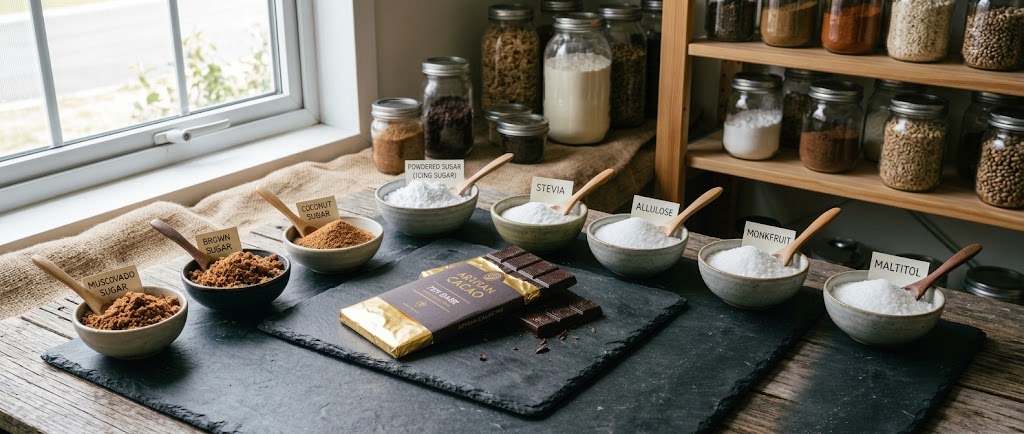
Formulators generally solve this in three layers. High-intensity sweeteners such as stevia and monk fruit deliver sweetness but contribute essentially no bulk. Bulk sweeteners such as maltitol, erythritol, and allulose rebuild the mass and particle structure.
Fibers such as inulin and chicory root improve mouthfeel and can soften the off-notes of the high-intensity sweeteners. Almost no sugar-free bar on the shelf uses just one ingredient, because no single ingredient does all three jobs.
Removing sugar from chocolate is not subtraction. It is reconstruction — and every substitute rebuilds a different part of what was lost.
A Field Guide to the Sweeteners
The names on the back of the wrapper fall into recognizable families, each with a distinct profile:
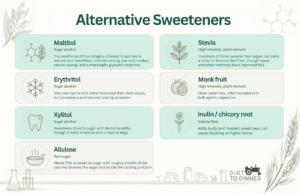
Maltitol’s economics illustrate the trade-off well. It delivers the mouthfeel manufacturers want, but at roughly 2.4 calories per gram, swapping it in yields a calorie reduction of only about 13% compared with sucrose.
Erythritol saves far more — but push it high enough to qualify for a “light” claim and the bar develops an unmistakable cool, almost minty sensation on the tongue, a consequence of its strongly negative heat of solution.
Allulose is the ingredient generating the most industry attention right now, precisely because it sidesteps several of these problems. It browns and bulks more like sugar without the cooling effect that complicates maltitol and erythritol formulations. However, there is litigation as to whether it really is sugar or not. The FDA says it is not and it has zero glycemic impact, yet plaintiffs are suggesting that the 0.4 calories per gram counts as ‘sugar’ (compared to sugar’s 4 calories per gram).
Tagatose is another great solution for sugar free. Considered a ‘rare sugar’ it comes from nature, such as apples, pineapples and the sap of a tree related to the cacao plant. It acts like sugar: it tastes sweet, browns, bulks, lowers the freezing point for frozen desserts, binds water, and has 60% fewer calories. Plus it has probiotic properties.
The Taste Problem Is Getting Smaller, Not Gone
The honest assessment is that sugar-free chocolate is meaningfully better than it was a decade ago and still detectably different from the real thing.
Cooling is the most common giveaway. When I bite into my favorite dark chocolate bark with almonds, there is definitely a cooling flavor. In addition, have you ever opened a chocolate bar and it is partly white?
While it is safe, it is called bloom. Bloom resistance and tempering behavior are the manufacturer’s headache — polyol-based bars can be harder to temper and more prone to developing that dull white surface film in storage.
Stevia’s bitter finish has improved substantially with better extraction and with blends that pair steviol glycosides with monk fruit compounds, but sensory panels can still pick it out.
Research on milk chocolate made with maltitol and xylitol found that high-maltitol formulations came close to conventional chocolate on moisture, particle size, and sensory scores — but that higher xylitol ratios changed viscosity and flow behavior noticeably. Getting it right is a matter of ratios, and small changes matter.
Then there is digestion. Sugar alcohols are incompletely absorbed in the small intestine, which is what makes them low-calorie and also what produces the bloating, gas, and laxative effects that the fine print warns about. This is dose-dependent and highly individual. One square is rarely a problem. Half a bar in one sitting, for many people, is.
The Health Question Is Not Settled
Erythritol deserves a specific mention because it has been the subject of debate and internet rumor.
A 2023 study in Nature Medicine from Cleveland Clinic researchers found that higher blood levels of erythritol were associated with increased cardiovascular event risk, and showed in mechanistic work that erythritol enhanced platelet reactivity and clot formation. Subsequent intervention work in healthy volunteers reported the same platelet effect, which glucose did not produce.
The counterargument is worth understanding. Erythritol is produced naturally in the human body through normal glucose metabolism, which means elevated blood levels may partly reflect underlying metabolic dysfunction rather than dietary intake — a classic confounding problem. And findings have been inconsistent across populations. The ARIC study of older adults found associations with heart failure hospitalizations and mortality, but not with the full range of outcomes reported elsewhere.
Erythritol currently retains GRAS status with the FDA. The researchers behind the cardiovascular work have argued that status deserves reevaluation. That is where the science sits: a genuine open question, not a settled verdict in either direction.
Labeling has its own gray area. The FDA has exercised enforcement discretion allowing allulose to be excluded from total and added sugars on the Nutrition Facts panel, while still counting toward total carbohydrates at 0.4 calories per gram. That is guidance, not regulation — a distinction that matters. A federal appeals court recently revived a proposed class action against Chobani from consumers who felt a “zero sugar” claim was misleading on a product containing allulose.
And a broader point on labels: only 16% of Americans correctly identified the Dietary Guidelines recommendation to keep added sugars under 10% of daily calories. Seven percent believe the recommended limit is zero. When people do not know the target, “sugar-free” becomes an easier heuristic than it should be.
The most useful question about a sugar-free bar is not whether it is healthier than a regular one. It is whether it fits a pattern of eating you can actually sustain.
Food for Thought
Sugar-free chocolate is a legitimate innovation serving a real need, particularly for people managing blood glucose or dental health. The taste gap has narrowed considerably, and allulose in particular is solving problems that stymied earlier formulations.
But it is not a free pass. These bars still contain fat and calories, sugar alcohols can cause real digestive discomfort at ordinary serving sizes, and the long-term data on some of these ingredients remains genuinely unsettled. A sugar-free label answers one question about a food and leaves several others open.
The Bottom Line
If chocolate is an occasional pleasure, the sugar-free version is a reasonable option and the regular version is a reasonable option. If chocolate has become a daily habit that a "zero sugar" claim now makes easier to justify, the sweetener is probably not the variable that matters most.
Share this article



Listen to the Dirt to Dinner Podcast