How Can Biotech Improve our Food System?
The Dirt
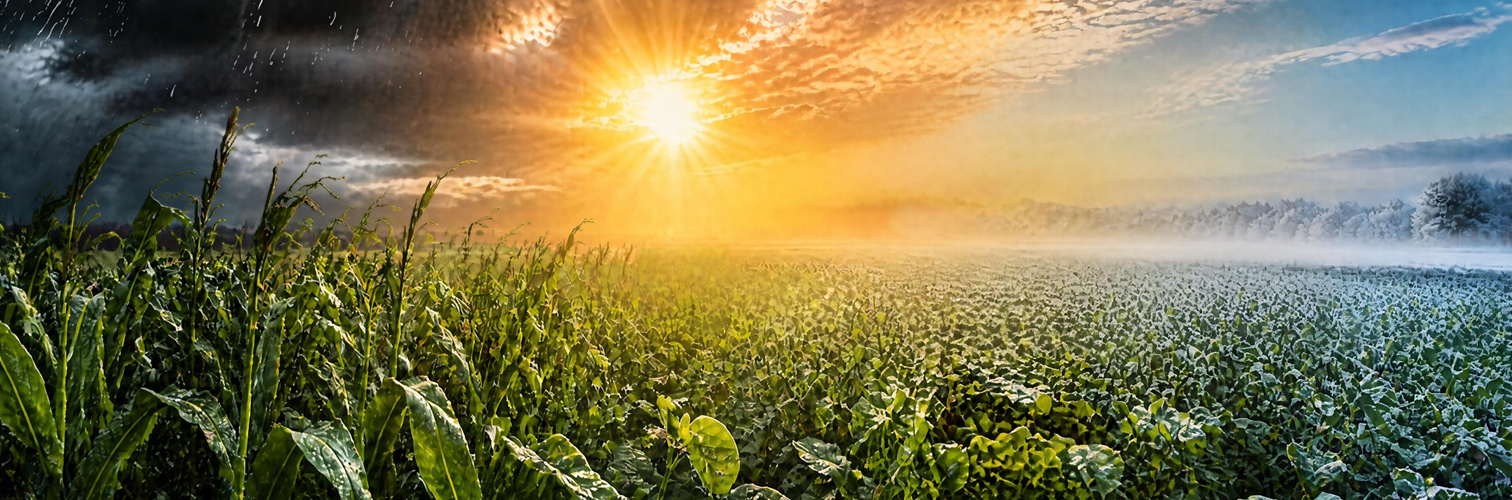
For decades, the GMO conversation has focused on familiar questions: Are genetically engineered crops safe? Do they reduce pesticide use? Can they help farmers grow more food? Now, a new study looking across more than 40 years of U.S. agriculture adds another question to the list: Have genetically engineered crops helped farmers grow food more reliably as weather and growing conditions become less predictable?
Global Food
Sustainable Agriculture
How Can Biotech Improve our Food System?
The Dirt
For decades, the GMO conversation has focused on familiar questions: Are genetically engineered crops safe? Do they reduce pesticide use? Can they help farmers grow more food? Now, a new study looking across more than 40 years of U.S. agriculture adds another question to the list: Have genetically engineered crops helped farmers grow food more reliably as weather and growing conditions become less predictable?
Researchers found that genetically engineered corn and soybeans were associated not only with higher average yields, but also with less year-to-year yield volatility and some protection against adverse climate effects. The technology also appeared to slow some of the northward movement in U.S. crop production associated with changing climate conditions.
That matters because crop resilience is about much more than getting through one difficult growing season. A more dependable harvest can help farmers plan with greater confidence, reduce catastrophic losses, stabilize income, and create more room to reinvest in things like better irrigation, precision agriculture, soil testing, improved machinery, and healthier soils (ie- a healthier world).
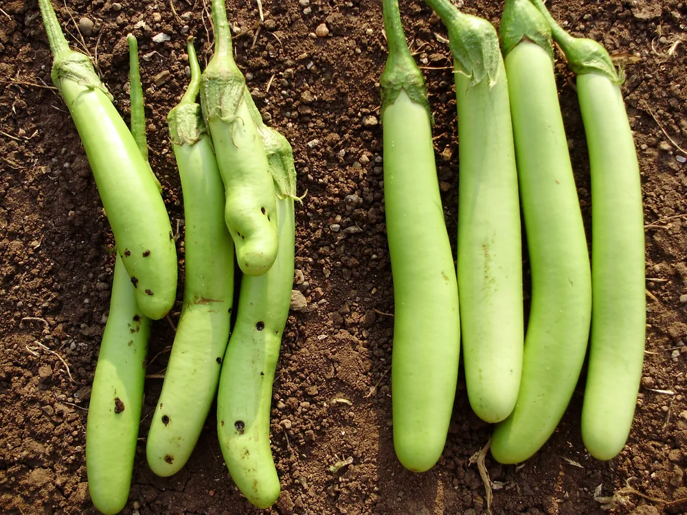
In other words, biotechnology may be doing more than helping farmers produce bigger harvests. It may be helping make agriculture more dependable. And when you are feeding millions of people, dependability matters.
Some genetically engineered traits can also reduce certain insecticide applications, support reduced-tillage systems, and help farmers produce more food on existing farmland.
Taken together, these benefits can create a larger ripple effect: More resilient crops, more stable farms, more efficient use of resources, greener practices and a more reliable food supply.
We’ve Been Talking About GMOs for a Long Time
At Dirt to Dinner, this is hardly our first conversation about crop biotechnology.
We have explained how GMOs work, explored their potential to improve yields and reduce agricultural inputs in our 5 Benefits of GMOs, and broken down the often-confusing difference between GMOs and CRISPR. More recently, the story has moved beyond traditional genetically engineered crops.
We looked at how biotechnology could make everyday foods more nutritious in Engineering Nutrition: The Crops Changing Public Health, including lettuce with more beta-carotene and vitamin C and tomatoes designed to provide more vitamin D. And earlier this year, we explored whether gene-editing technology could rescue crops facing disease, drought, heat, food-safety challenges, and other threats.
Those stories largely asked a forward-looking question: What might biotechnology allow us to do?
This new research asks something different:
After decades of farmers actually using genetically engineered seeds, what can we now see happened in the fields?
A 40-Year Experiment Hidden in America’s Farmland
Imagine trying to test whether a technology helps agriculture cope with changing weather. Ideally, you might plant thousands of identical farms across the country. Half would use genetically engineered seeds, half would not. You would expose them to the same heat, rainfall, insects, soil conditions, and management practices for decades, then compare the results. Of course, no such experiment exists.
Instead, researchers Caroline Yifan Dong, Chengcheng Fei, Bruce McCarl, David Zilberman, and Xingguo Wang used something much larger: America’s actual agricultural history.
Their new study in Nature Climate Change analyzed crop production, climate, land use, and genetically engineered crop adoption across the United States from 1978 through 2020. That time span matters.
Commercial adoption of genetically engineered crops accelerated in the 1990s. According to the USDA Economic Research Service, today’s major GE crops include corn, soybeans, and cotton, particularly varieties engineered for insect resistance, herbicide tolerance, or both.
That gave researchers years of agricultural data before widespread adoption and decades of experience afterward. They then asked several questions:
- Did yields change?
- Did they become more or less volatile?
- Did changing temperatures and rainfall affect GE crops differently?
- And did biotechnology influence where farmers could continue successfully growing these crops?
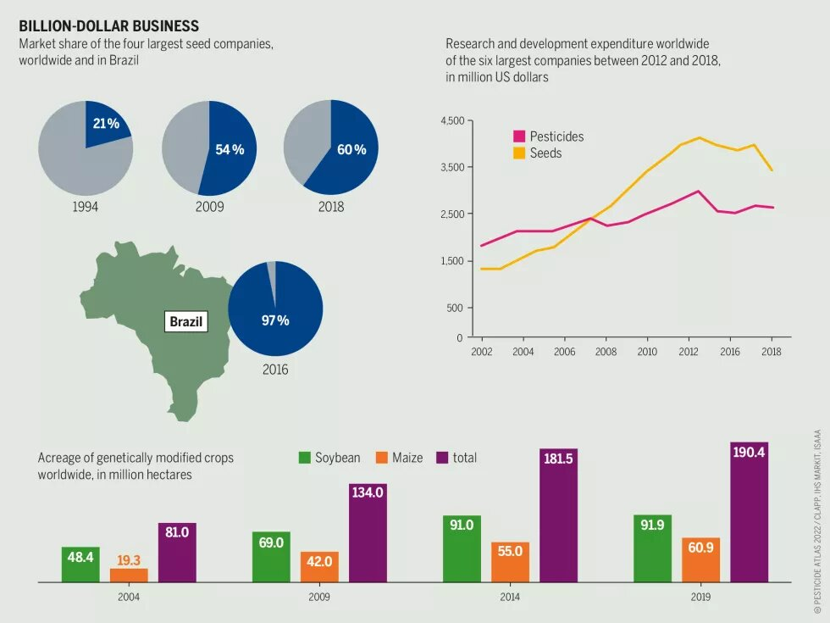
The researchers concluded that GE adoption was “broadly associated with yield benefits,” with higher yields and lower yield volatility in corn and soybeans, partial buffering of damaging climate effects, and more modest benefits in cotton. But the word volatility may be the most important part of that sentence.
Bigger Harvests Get Attention. Reliable Harvests Matter, Too.
We tend to measure agricultural progress by asking how much more we can grow. If an acre of farmland once produced 150 bushels of corn and now produces 180, the improvement is easy to see.
But imagine two farmers whose fields both average 180 bushels over several years:
- Farmer A harvests roughly 175, 182, 178, 184, and 181 bushels – planning ahead pays off in consistent yield
- Farmer B harvests 220 one year, then 135, 210, 145, and 190 – this farmer is riding an agricultural roller coaster
Their averages may eventually look similar, but their businesses do not.
Farmers have to buy seed, fertilizer, equipment, fuel, and crop-protection products months before harvest. Grain elevators need to anticipate storage. Livestock producers depend on crops to feed their animals. Food manufacturers contract for ingredients. Exporters negotiate shipments. A wildly unpredictable harvest can ripple far beyond the field where the crop was grown.
This is what makes the new study interesting. For corn and soybeans, GE adoption was associated not just with higher production, but lower year-to-year variability in production. Think of resilience as suspension on a car. Good suspension does not make the potholes disappear. It reduces how violently the car reacts when it hits them.[SL1]
Likewise, a resilient crop does not make drought, excessive heat, insects, or heavy rainfall disappear. It may simply help soften the blow. And softening the blow has consequences. A farmer who repeatedly loses large portions of a crop may have little financial flexibility beyond covering the next season’s bills. A farmer with more dependable yields has a better chance of investing in the next improvement.
On a farm, those options might include improved irrigation, precision nutrient application, drainage, newer equipment, cover crops, better storage, or technology that can make the next crop healthier and more efficient. That is why resilience can compound over time.
Resilience Can Also Mean Doing More With Less
The environmental side of this story matters, too. Not every GMO reduces every crop input, and the benefits vary by crop, trait, geography, and management system. But certain genetically engineered traits have delivered measurable efficiencies. Insect-resistant crops, for example, can reduce the need for some insecticide applications because the plant itself is protected against specific pests.
Herbicide-tolerant systems have, in some cases, helped support reduced-tillage or no-till practices. That can mean fewer tractor passes across a field. Fewer passes can mean less fuel use. Less tillage can mean less soil disturbance. And if farmers can produce more food reliably on the same acreage, there may be less pressure to compensate for poor yields by bringing additional land into production.
That last point is especially important. A farm’s environmental footprint is not just about how many pounds of fertilizer, pesticide, or fuel it uses. It is also about how much food is produced from those resources. If one acre produces more food with the same or fewer inputs, the environmental cost per bushel or pound of food can fall.
That is a much more useful way to think about efficiency. The goal is not simply “use less.” It is using resources more productively.
Here’s the Surprising Part: Most Were Not “Climate Crops”
It would be easy to assume these crops were genetically engineered specifically to survive climate change. Most were not.
The major first generation of genetically engineered crops planted across American farmland primarily offered farmers traits such as insect resistance and herbicide tolerance. Bt corn, for example, is engineered to defend itself against certain destructive insects. Herbicide-tolerant crops give farmers additional tools for controlling weeds competing with crops for sunlight, nutrients, space, and water.
Neither trait sounds like a weather technology. But a corn plant does not experience stress one problem at a time.
Picture trying to run a marathon on a very hot day. Now imagine doing it while fighting the flu and carrying a heavy backpack. Removing either of those additional burdens will not cool the weather, but it may make coping with the heat a little easier.
Plants face similar stacks of stress. During drought or excessive heat, a plant already has limited resources. Add significant weed competition or insect damage, and those resources are stretched even further.
The new research suggests that the combination of GE crop development and the farming practices surrounding it may have helped buffer some climate-related stress. That does not mean every GE trait automatically makes a plant climate-resistant. It means biotechnology may contribute to resilience even when “climate resilience” was not the original trait printed on the seed bag.
America’s Farm Map Is Moving
There was another finding that may be even harder to picture from the grocery aisle: where America grows crops is changing.
Farmers do not simply decide where corn, cotton, or soybeans should grow based on tradition. Agricultural geography is influenced by growing-season temperatures, rainfall, frost dates, soils, pests, water availability, and economics. When those conditions change, crop production can move.
Over the study period, researchers observed northward shifts in cultivation. Previous research has shown that climate is one contributor to these geographic changes. But when the researchers modeled what U.S. agriculture might have looked like without genetically engineered crop adoption, they found something intriguing: GE adoption appeared to dampen some of that climate-driven northward movement.
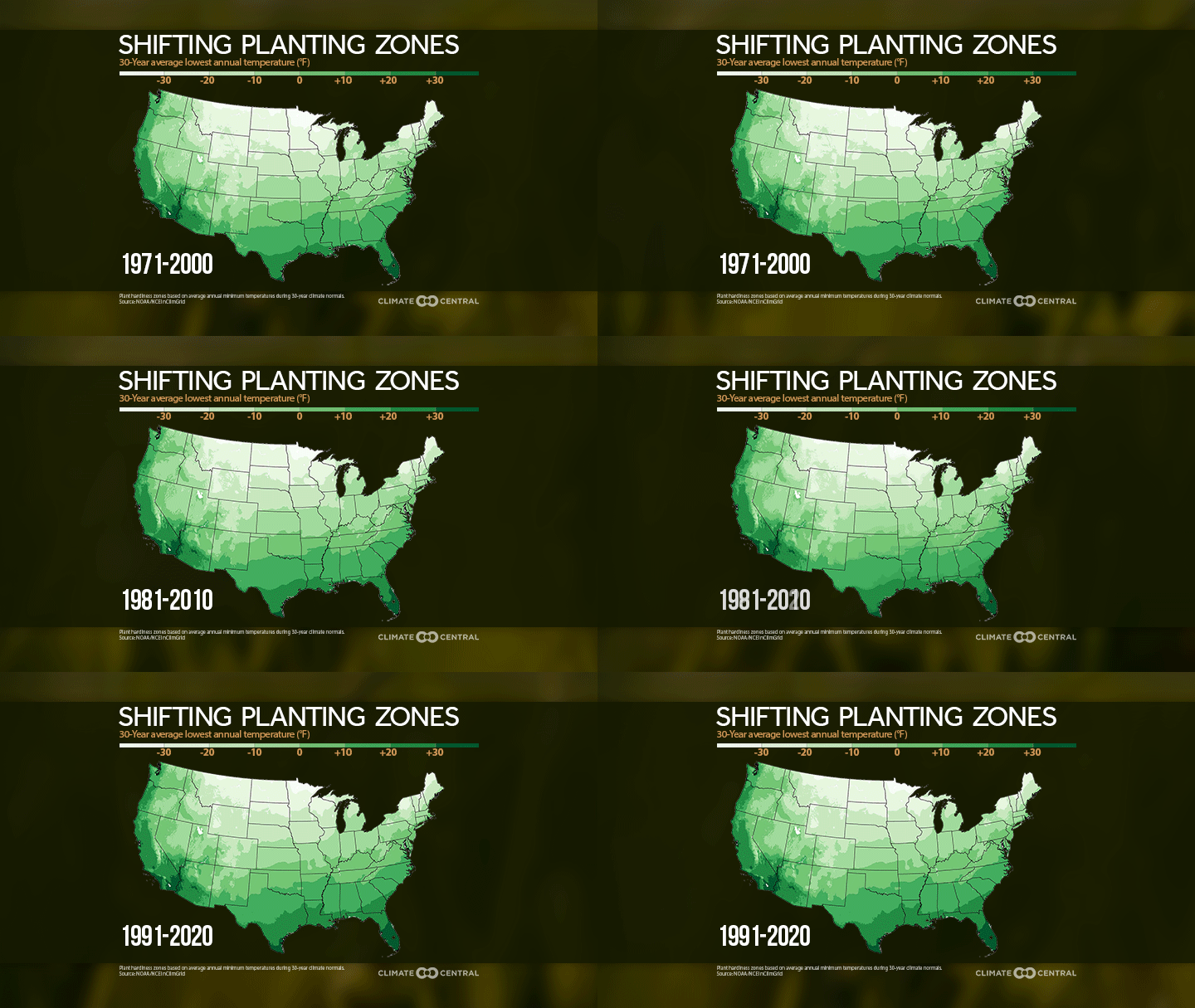
In plain English, biotechnology may have helped some farmers maintain production in regions where changing conditions otherwise would have placed greater pressure on cultivation to move elsewhere.
That does not mean the Corn Belt is staying frozen on a map forever. It suggests technology may give farmers more room to adapt where they already are. And there are consequences when agriculture has to move. New crop acreage can require different infrastructure, transportation networks, storage, processing capacity, irrigation, and potentially conversion of other land to agricultural production. Keeping existing productive farmland productive can therefore matter well beyond an individual farm.
Why Does This Matter to Someone Buying Groceries?
Most of us will never choose corn seed or worry about soybean yields. We choose tortilla chips, cereal, chicken breasts, cooking oil, milk, eggs, and hundreds of other foods connected directly or indirectly to American agriculture. Corn and soybeans are major livestock feed crops, so what happens in those fields does not necessarily stay in the produce or grain aisle.
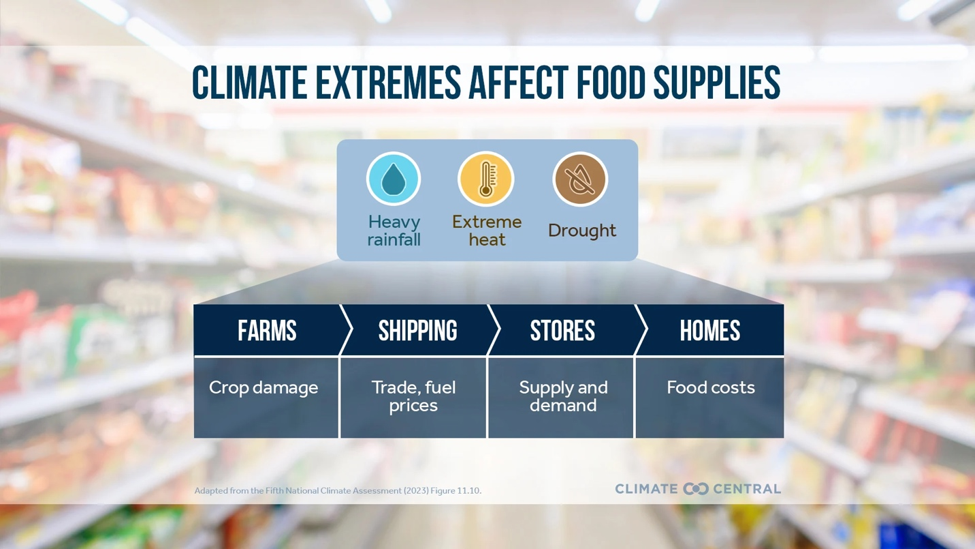
When harvests become less reliable, the effects can travel through storage facilities, feed markets, transportation networks, food manufacturers, livestock farms, and eventually grocery supply chains.
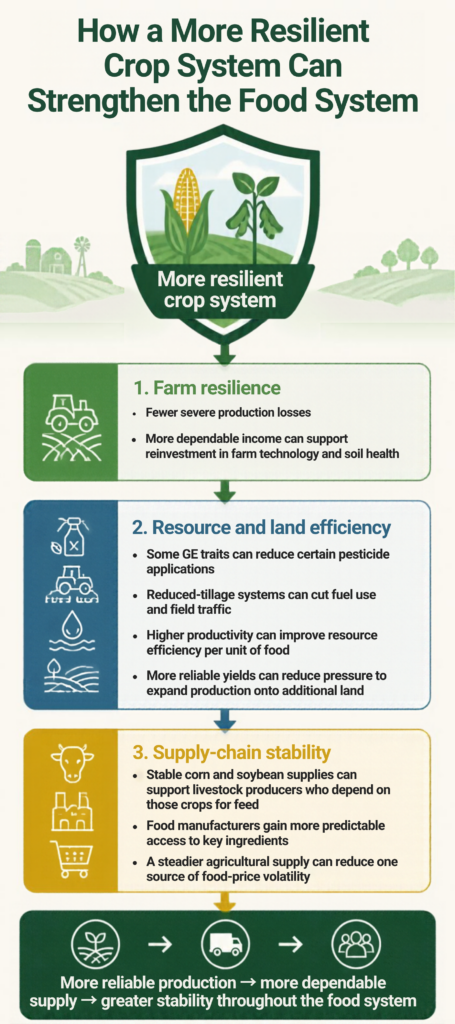
None of this means GM crops guarantee cheaper groceries. Food prices are influenced by labor, transportation, energy, weather, trade, processing, packaging, and global demand.But a food system built on more reliable harvests starts from a stronger position than one built on unpredictable ones. For consumers, “yield stability” sounds like agricultural jargon.
At its simplest, it means something much more familiar:
Will there still be enough to go around after a difficult growing season? And the evidence suggests the next chapter of the GMO conversation may be less about producing the biggest harvest possible under perfect conditions and more about something arguably just as important: producing food reliably when conditions are anything but perfect.
Genetically engineered crops have long been evaluated for their safety, productivity, environmental impact, and ability to protect plants from insects and weeds. New long-term research adds another consideration: stability. Across four decades of U.S. agriculture, GE adoption was associated with higher yields and lower yield volatility in corn and soybeans, some buffering against adverse climate effects, and less climate-driven movement of crop production northward. Those benefits can extend beyond the plant itself.
More reliable crops can support more stable farm income, encourage reinvestment in technology and soil health, improve resource efficiency, reduce certain inputs in some systems, lessen pressure on additional farmland, and strengthen the reliability of the broader food supply. Biotechnology will not solve every agricultural challenge.
The Bottom Line
As farmers contend with more variable growing conditions, the ability to make crops not just productive but dependable may become biotechnology's most important benefit, and it highlights where the technology stands today and where it can take us.
Share this article



Listen to the Dirt to Dinner Podcast