Source: CDC
Protecting Your Plate from Cyclospora
The Dirt
A rapidly expanding Cyclospora outbreak is sweeping across the country this summer, turning grocery shopping and dining out into a source of anxiety. Before you clean out your fridge, read on to discover what research shows about how this parasite spreads and the simple, proven steps you can take to protect your family.
Global Food
Protecting Your Plate from Cyclospora
The Dirt
A rapidly expanding Cyclospora outbreak is sweeping across the country this summer, turning grocery shopping and dining out into a source of anxiety. Before you clean out your fridge, read on to discover what research shows about how this parasite spreads and the simple, proven steps you can take to protect your family.
Just when we thought it was safe to enjoy summer picnics and backyard barbecues, a microscopic party-crasher has made its way into the headlines. If you’ve been keeping an eye on the news lately, you’ve probably heard about a rapidly expanding outbreak of a parasitic infection causing some seriously miserable gastrointestinal distress across the country.
The culprit? Cyclospora cayetanensis—a single-celled parasite that gives a whole new meaning to the phrase “stomach bug.”
At Dirt to Dinner, we are all about helping you navigate the food supply with clear facts rather than fear. Let’s break down exactly what’s happening, how this parasite operates, and what you can do to stay healthy.
A Rapid Summer Surge
According to public health departments and tracking data, the summer of 2026 has brought a massive, unexpected surge in cyclosporiasis cases. The outbreak continues to expand rapidly, causing widespread health alerts as health officials trace thousands of cases of severe, prolonged diarrhea.
According to the CDC’s Cyclospora Surveillance Data, cases naturally peak between May and August.
Pinpointing an exact culprit is notoriously difficult because the parasite has a lengthy incubation period, usually taking about a week or more for symptoms to appear after you eat contaminated food.
Federal investigators routinely track case clusters linked to restaurants, grocery chains, and catered events during these seasonal surges. As of this writing, the U.S. Food & Drug Administration reported that the iceberg lettuce supplied to Taco Bell locations in Indiana, Kentucky, Michigan, Ohio, and West Virginia have been linked to the outbreak. Once the lettuce supplier has been confirmed, the FDA will report other food retailers that may be impacted by this contaminated ingredient.
What makes tracing this parasite incredibly complicated is that a single agricultural supplier can distribute different types of produce to multiple competing grocery stores, fast-food chains, and restaurant networks. If contaminated produce was on the shelves a few weeks ago, it likely went to a wide variety of locations rather than one single chain.
But what we do know is that Cyclospora loves to hide in fresh herbs like basil and cilantro, lettuces, pre-packaged salad mixes, raspberries, and berry-fruit blends.
How This Parasite Spreads
First, let’s get something straight: you won’t contract cyclosporiasis from someone else.
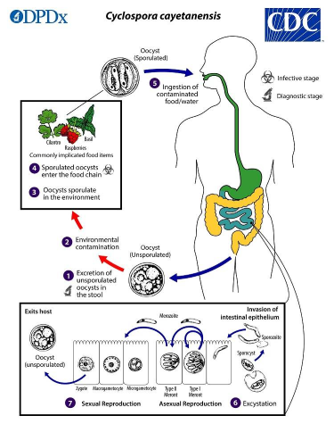 If someone in your house catches a typical stomach flu, you immediately start bleaching doorknobs. But Cyclospora is different. According to the CDC’s Clinical Overview, it is highly unlikely to spread directly from person to person.
Instead, it spreads through the fecal-oral route, usually via contaminated agricultural water. When feces containing the parasite find their way into irrigation systems or water used to spray crops, the parasite’s eggs (called oocysts) are deposited onto the produce.
Once out in the warm, humid environment of a farm field, these oocysts take several weeks to mature and become infectious. When we eat that produce raw, the parasite hitches a ride into our small intestine, causing weeks of watery, often explosive diarrhea, cramping, bloating, and fatigue.
Who Needs to Be Most Vigilant?
For a healthy adult, Cyclospora is incredibly uncomfortable, often described as feeling full, bloated, and miserable for weeks on end. It eventually resolves itself without medical intervention, but it can take up to six weeks.
However, some of us need to take extra precaution during outbreaks like this. Infants, older adults, pregnant women, and anyone with a compromised immune system face a much higher risk of severe, prolonged illness.
In these sensitive populations, the body cannot easily fight off the parasite on its own. The resulting weeks of relentless diarrhea can cause dangerous, rapid dehydration, imbalances in vital electrolytes, and significant weight loss.
If you or someone you know who’s immunocompromised has a persistent stomach bug that simply won’t quit, see a doctor and specifically request a Cyclospora test, as this parasite goes undetected on standard stool tests. Fortunately, once identified, it can be treated effectively with specific antibiotics.
Best Practices to Reduce Your Risk
When outbreaks happen, the internet fills up with DIY “hacks” to protect your gut. Let’s look at the actual science behind what works and what doesn’t based on official safety standards and the CDC’s Prevention Guidelines:
Here’s what works:
- Cook Leafy Greens: The absolute surest way to neutralize Cyclospora is heat. The parasite is completely killed when cooked thoroughly, to 158 degrees F. While we love a raw summer salad, switching to cooked greens—like sautéed spinach, kale, or cooked bok choy—completely eliminates the biological risk during an active outbreak.
- Head to the Freezer Aisle: If you can’t resist your morning smoothie but want to avoid fresh berries during a surge, buy frozen berries instead. Large-scale commercial freezing operations follow rigorous processing safeguards, and while freezing doesn’t completely guarantee eradication of all pathogens like heat does, the intense washing and strict processing standards drastically minimize the likelihood of contamination.
- Greenhouse-Grown Produce: While not 100% immune to human handling errors, indoor-grown greens are a vastly safer bet during a major water-borne parasite outbreak. These operations work in closed-loop, highly controlled environments, meaning they don’t have to worry about wild animal intrusion, agricultural runoff, or contaminated open-air river water spraying their crops.
- Practice Good Food Hygiene: Though it’s not a surefire way to eliminate Cyclospora, proper food prep helps avoid cross-contamination by separating your food items and then washing your hands, utensils, and countertops with hot, soapy water before and after handling fresh produce.
- Stay Informed: Because Cyclospora outbreaks are intensely tracked by state and federal epidemiologists, check regular updates from FoodSafety.gov’s Recalls & Outbreak Page, download the FoodKeeper App, or subscribe to the FDA Recall Mailing List. If specific brands, pre-packaged salad mixes, or grocery distributors are named or recalled, check your fridge immediately and discard the products.

Less effective practices against Cyclospora:
- Produce Baths: A major myth circulating online is that soaking your veggies in a vinegar, baking soda, chlorine or bleach solution will “kill” the parasite. But unfortunately, oocysts have a tough, protective outer shell that shrugs these products off. And a quick word of caution: never use a bleach solution for anything other than cleaning hard surfaces.
- But let’s not toss out the vinegar rinse completely here. Because of its acetic base, vinegar is a reasonably successful agent to reduce surface bacteria and extend shelf life. Just be sure to mix one part vinegar to three parts water to make it effective without affecting taste.
- And because of its carbonated action, a baking soda soak is great for loosening dirt and washing off pesticide residues. Just use one teaspoon of soda for every 2 cups of water.
- Shopping at Farmers Markets: We love supporting local agriculture, but shopping at a local farmers market doesn’t automatically mean your food is safer from parasites. Small, local farms use the same open-air fields, soil, and regional irrigation systems as larger operations. If a local farm’s water source is compromised by wildlife or local runoff, their produce can carry the same risks, so aim to buy produce that you’re planning to cook.
- Buying Domestic Produce: Prior to 2018, almost all identified Cyclospora outbreaks in the U.S. were tied to imported produce, mostly from tropical environments. However, this paradigm changed in 2018, when the National Advisory Committee on Microbiological Criteria for Foods found the majority of heavily investigated, large-scale U.S. outbreaks have been linked to domestically grown crops, specifically pre-packaged leafy greens and domestic vegetable trays.
- Probiotics and Supplements: While maintaining a healthy microbiome with probiotics is great for overall digestion, they will not prevent or cure a parasite. Cyclospora is a resilient, physical organism, not a bacterial imbalance. If you swallow an active oocyst, a capsule of bacteria or nutrient supplement isn’t going to stop it.
The Bottom Line
Food safety requires balancing common sense with real science. While this Cyclospora outbreak warrants careful food prep and smart sourcing, it shouldn't scare you away from fruits and vegetables entirely. By understanding how the parasite spreads, opting for cooked greens, frozen berries, and indoor-grown produce during active alerts, and sticking to proven kitchen hygiene, you can comfortably protect your health without sacrificing your nutrition.
Share this article



Listen to the Dirt to Dinner Podcast