The FDA’s ‘Ultra-Processed’ Definition Is Coming…
The Dirt
The government is proposing to define "ultra-processed food" for the first time. The definition itself won't change a single label. But it could become the yardstick for school lunches, SNAP rules, and labeling fights for years. We're covering the dictionary now because by the time the rulebook arrives, the language will already be settled.
Nutrition
The FDA’s ‘Ultra-Processed’ Definition Is Coming…
The Dirt
The government is proposing to define "ultra-processed food" for the first time. The definition itself won't change a single label. But it could become the yardstick for school lunches, SNAP rules, and labeling fights for years. We're covering the dictionary now because by the time the rulebook arrives, the language will already be settled.
In my kitchen right now, there is a loaf of bread, a box of crackers my kids demolish after school, and a bag of frozen berries for smoothies. Under the definition most researchers use, the bread and the crackers count as “ultra-processed.” The berries don’t. What’s surprising is that sugary products, like sodas and candy bars, are lumped into the same category as my whole-grain bread and flax crackers.
If you’re wondering about the credentials for this strange category, you’re asking the right question. The federal government is about to define parameters for what constitutes “ultra-processed foods”, and when it does, the fine print will matter more than the headline.
What actually happened
Here’s the timeline. In July 2025, the FDA and USDA put out a joint call for data, a formal Request for Information asking researchers, companies, and the public to help build a “uniform definition” of ultra-processed foods. The idea, the agencies said, was consistency: if everyone means the same thing by “ultra-processed,” research can actually be compared and policy can be built on it. More than 5,000 comments came in by the time the window closed on October 23, 2025.
Then, on August 10, 2026, HHS and USDA announced they’d sent a proposed definition to the White House budget office, the Office of Management and Budget (OMB), for final review. As of October 13, the text still hasn’t been released. OMB’s public calendar shows a string of meetings on the “White Paper: Proposed Definition of Ultra-Processed Food” running through September and into October 2026, some of the last formal chances to get data and perspective in front of decision-makers before it publishes.
What’s new: This is the first time the federal government has tried to put its own pin in what “ultra-processed” means.
What’s established: We’ve been arguing about the concept for more than 15 years without one.
As UNC food-policy researcher Lindsey Smith Taillie put it: “You have to know what it is that you’re intervening on.” A definition is the precondition for everything downstream, from school-meal rules to label warnings.
Why we don’t already have a definition
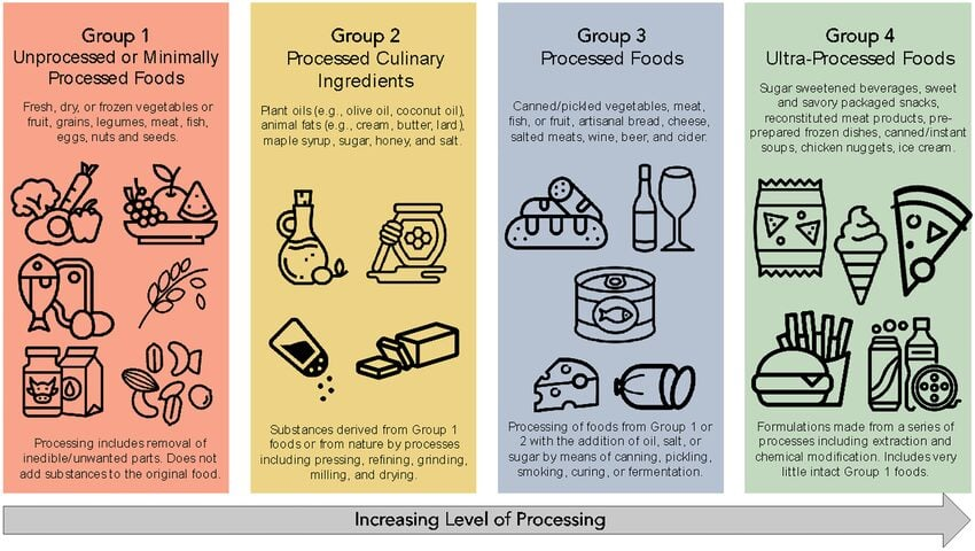
The system most researchers use today to determine degree of food processing is called NOVA. It was created by Brazilian researchers in 2009 and sorts food not by nutrients, but by how much it’s been altered. In NOVA’s world, “ultra-processed” roughly means products made with ingredients you’d never find in a home kitchen: certain preservatives, artificial flavors, highly refined sweeteners, and industrial formulations. It does not consider the nutritional content of the food, simply the ingredients.
NOVA was a breakthrough, and it also has a well-known flaw: it’s a very big category. As one recent analysis put it, it lumps a sugary soda in with fortified whole-grain bread, even though those foods aren’t nutritionally alike. Researchers have struggled to classify the same foods the same way twice, and a 2025 review found six different classification systems, each with its own criteria.
Dozens of observational studies link high ultra-processed food consumption to obesity, cardiovascular disease, and diabetes, but researchers still haven’t pinned down which ingredients, additives, or processing methods actually drive those associations, or at what exposure levels.
My favorite illustration of where the science stands comes from Kevin Hall, a senior investigator at the National Institutes of Health. Hall thought the whole ultra-processed concept was, in his words, “nonsense” and “anti-science.” He said so publicly in a debate with food writer Marion Nestle. So he ran the experiment to prove it.
Hall housed 20 adults at the NIH Clinical Center for four weeks. For the first two weeks, the subjects ate a diet of “ultra-processed” foods (using the NOVA definition), then they switched to a diet of unprocessed foods for the last two weeks. The diets were designed to have similar amounts of calories and key nutrients, and participants were told to eat as much as they wanted.
The result embarrassed the hypothesis: people ate more and gained weight on the ultra-processed menu. “This is the first study to demonstrate causality,” Hall said, “that ultra-processed foods cause people to eat too many calories and gain weight.”
Hall’s trial is the strongest evidence in the field. It’s also one small, short study. It tells us the effect is real without telling us exactly what causes it, which is precisely why the definition’s fine print matters so much. That’s the gap a federal definition is supposed to help close. HHS has described the goal as creating “a stronger foundation for future nutrition research.” Think of it as agreeing on the ruler before arguing about the measurement.
A white paper, not a rule: what’s the difference?
This is the part most coverage skips, and it’s the most important. The agencies have been clear: this is coming as a white paper, not a regulation. A white paper is the government thinking out loud on paper. It has no legal force. It doesn’t pull anything off shelves, change a label, or ban an ingredient.
Here’s an analogy: a white paper is a dictionary, and a rule is a speed limit. A dictionary doesn’t give you a ticket. But once everyone agrees on what a word means, it’s a lot easier to write the speed-limit sign.
And dictionaries get cited. As legal analysts at Greenberg Traurig noted this month, calling it research-focused “does not determine whether or how it may be used later in policymaking, regulatory activity, or litigation.” Once a federal definition exists, anyone can point to it: a state legislature writing a school-meals bill, a retailer setting procurement standards, a plaintiff’s attorney building a case. Whether it ever becomes enforceable is a separate decision the administration hasn’t made yet. But the definition becomes the benchmark everything else references.
That’s why the OMB meetings matter. They’re one of the last formal windows for input before the text locks.
The three dials that will decide everything
The entire fight comes down to what the definition keys on. Legal analysis describes three possible dials (processing methods, ingredients, nutrients, or some combination), and where the agencies set each one determines which foods land inside the category.
Dial 1: Processing methods
Does the definition care how the food was made? Extrusion, hydrogenation, industrial formulations you couldn’t replicate at home? This is NOVA’s home turf.
Dial 2: Ingredients
Does it flag what’s in it: specific additives, flavorings, colorings, preservatives? This is the most concrete dial, and the one industry watches closest, because an ingredient list is something you can reformulate around.
Dial 3: Nutrients
Does it weigh the food nutritionally? Added sugars, sodium, saturated fat? This dial looks the most like our existing nutrition labels, and it’s where a UPF definition could overlap, or collide, with everything from front-of-package labeling to dietary guidelines.
If you turn all three dials to the strictest setting, almost all items in grocery stores count as “ultra-processed”. And if you loosen up the dials, significantly fewer items qualify. The definition’s authors have to find the setting that’s scientifically defensible, and that’s the hard part, because the science hasn’t settled which dial matters most for health.
What’s already moving
Washington isn’t waiting in a vacuum. California passed a framework and directed rulemaking around a definition of UPFs. In the Senate, the Childhood Diabetes Reduction Act was introduced in August, and the Food Labeling Modernization Act was introduced in July and referred to committee. Neither uses the same criteria as the others. Add in state bills, enforcement activity, and private lawsuits, and you have at least three definitions that don’t agree with each other.
Industry, unsurprisingly, has opinions. The Consumer Brands Association, which represents companies like PepsiCo, Nestle, and Kraft Heinz, has cautioned that “any so-called definition that captures 80% of the nation’s food supply while picking winners and losers is fundamentally flawed,” in the words of spokesperson Rhonda Bentz. Bloomberg reported that CEOs and trade groups lobbied the White House to slow the white paper’s release, expressing concern that the research is not yet robust enough to inform policy, while a definition would increase costs and litigation.
Food-law attorney Alan Sachs told Food Ingredient’s Global Insights that because this is a white paper and not a regulation, the administration isn’t obligated to publish it by any date, or at all, and it could still be modified while under review.
Public-health groups are pushing the other way. “A federal definition would represent an important step toward strengthening the science that informs future nutrition policies and consumer choices. It is time to take that step,” said Dr. Mariell Jessup of the American Heart Association, one of the few public-health groups granted an OMB meeting so far.
Both sides understand the same thing: the dictionary gets written once, and then everybody has to use it.
What should you actually do with this news?
What’s key here for us as consumers is that the definition won’t tell you what’s healthy. It will tell you what counts, and then the arguing about what to do with the count begins. You’ll still need to remember that everything is better in moderation.
And you will still need to remember to include five to seven servings of fruits and vegetables, eat 25-30 grams of fiber, eat a minimum of 0.85 grams per pound of ideal body weight, and healthy fats.
Nothing in your cart needs to change today. I pack my five-year-old’s lunch most mornings, and I’ll pack it the same way next week. This definition won’t make any food illegal, and it won’t, by itself, change a single label or my understanding of proper balance nutrition.
But here’s the proportionate take: definitions are infrastructure.
A UPF definition is the shared language that may let researchers compare studies, could allow SNAP and school-meal programs to write rules that mean the same thing in every state, and may let labeling debates argue about policy instead of arguing about the dictionary.
What’s new is that the federal government is finally writing that dictionary entry. What’s established is that the science underneath it is still catching up. We know that observational studies have shown dietary patterns high in ultra-processed foods may be associated with real health risks, but we don’t yet know precisely which dials to turn.
Watch two things when the text drops: which of the three dials — processing, ingredients, nutrients — does the most work, and who cites it first. The first tells you how scientific the definition is trying to be. The second tells you how political it’s about to become.
The Bottom Line
The UPF definition could come any day. The debate it starts will last years, which is exactly why we're writing about the dictionary before anyone writes the rules.
Share this article



Listen to the Dirt to Dinner Podcast