Ditching the Daily Diet Scorecard
The Dirt
What should we eat each day? And what should only be a part of our diets on a monthly basis? This might be the new way to look at your diet that is encouraging for you, and supports the latest research on our new food pyramid.
Nutrition
Ditching the Daily Diet Scorecard
The Dirt
What should we eat each day? And what should only be a part of our diets on a monthly basis? This might be the new way to look at your diet that is encouraging for you, and supports the latest research on our new food pyramid.
Click Play to listen to our generated podcast. Access our full podcast library here.
It starts the same way for almost everyone. You wake up with good intentions. Today is going to be different. More protein. More vegetables. Don’t forget the fiber. Less sugar. By mid-morning, you’ve already adjusted. Lunch is rushed. Dinner is late. Someone suggests takeout. The kids want pasta. You didn’t hit your protein goal. You forgot vegetables at lunch. You had dessert.
Again. And just like that, the quiet thought creeps in: I failed today. But what if you didn’t? What if the problem isn’t your discipline, or even your food choices, but the fact that you’re trying to measure health in 24-hour increments? The newest Dietary Guidelines and the broader Make America Healthy Again movement are pushing an important shift: Health is built in patterns and consistency. And yet, most of us are still grading ourselves like every meal is a final exam.
The Shift: Stop Trying to Win the Day
The human body doesn’t operate on a daily scorecard. Variability in our daily eating habits isn’t failure, it’s normal. What matters is what happens across a week, not a single day.
As Dr. Andrew Huberman often emphasizes in his work on behavior and neurobiology, it’s the patterns you repeat, not the occasional deviation, that shape long-term outcomes. A single “off” day doesn’t define your health, but consistently misaligned habits can.
So instead of asking: Did I eat perfectly today? A better question is: Did I have a solid week? Did I achieve my goals for the month?
A New Food Pyramid
The modern “food pyramid” isn’t a daily checklist anymore. It’s a rhythm.
Your daily foods are the ones that quietly shape your metabolism, your energy, and your long-term health. They don’t need to be complicated, but they do need to be consistent.
Protein
At the center of this foundation is protein.
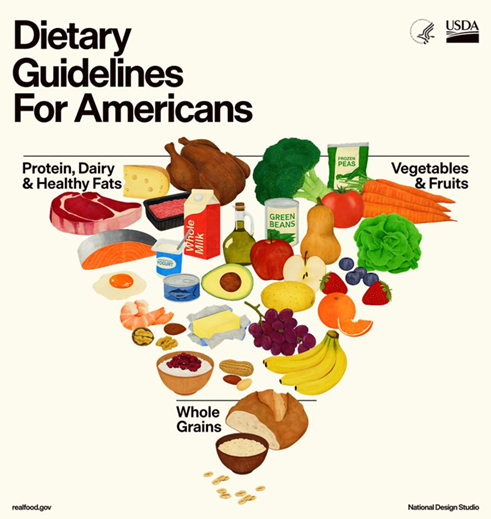
Modern research increasingly shows that most adults benefit from roughly 1.2 to 1.6 grams per kilogram of body weight per day, which translates to about 0.55 to 0.73 grams per pound. This is higher than older minimum recommendations, but aligns with newer findings on muscle preservation, metabolic health, and satiety.
To make this more practical, protein needs are often best based on ideal body weight, rather than current weight—especially for those trying to lose fat or improve body composition. Ideal body weight is typically defined as the weight associated with a healthy BMI range (roughly 18.5–24.9) or a weight where you feel strong, energized, and metabolically healthy.
For example, someone with an ideal body weight of 150 pounds would aim for approximately 80 to 110 grams of protein per day, spread across meals.
Studies over the past decade consistently show that higher protein intake helps regulate appetite, maintain lean mass as we age, and stabilize blood sugar levels throughout the day. Protein sources like red meat, chicken, fish, and pork not only provide variety, but make it easier to consistently meet these targets.
Just as important is how that protein is distributed. Rather than loading it all into dinner, spreading protein across meals appears to better support muscle protein synthesis and energy levels.
Fruits and Vegetables
Alongside protein, fruits and vegetables remain the most under-consumed, and most impactful, part of the modern diet. A simple, achievable target is about five servings per day: roughly three servings of vegetables and two of fruit. Large-scale prospective studies have consistently linked this level of intake to lower risk of cardiovascular disease, improved gut health, and reduced overall mortality.
Fiber
Fiber plays a central role here. Most Americans fall well short of the recommended 25–35 grams per day, yet fiber intake is strongly associated with better metabolic health, improved cholesterol levels, and a more diverse gut microbiome. Practically, this looks like adding spinach or peppers to eggs in the morning, including vegetables at lunch, and building dinner around a vegetable-forward plate rather than treating them as an afterthought.
Healthy Fats
Healthy fats, once broadly feared, are now recognized as essential. Foods like olive oil, avocados, nuts, eggs, and fatty fish provide not only energy, but also support hormone production, brain function, and the absorption of key nutrients. Research over the past two decades has shifted away from blanket fat restriction toward a more nuanced understanding: the type of fat matters far more than the total amount.
Whole Grains
Whole grains round out this foundation, offering sustained energy and additional fiber when consumed in their minimally processed forms. Oats at breakfast, quinoa in a lunch bowl, or a side of brown rice at dinner all contribute to more stable blood sugar and longer-lasting satiety compared to refined carbohydrates.
Taken together, these daily foods don’t require perfection or precision. A breakfast might be as simple as eggs and fruit, lunch a protein-forward salad or bowl, and dinner a straightforward combination of protein, vegetables, and grains.
The goal isn’t to optimize every bite, it’s to make sure these foods show up, again and again, most of the time.
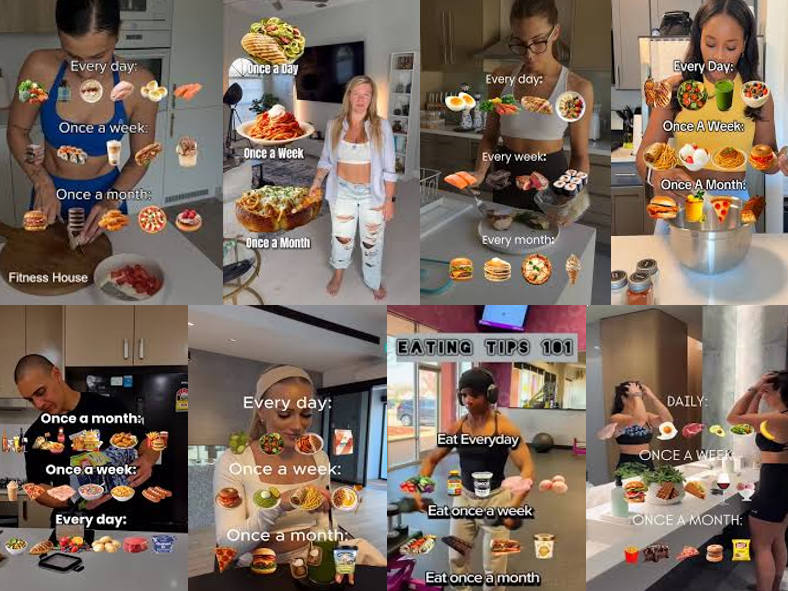
What to Eat Each Week: The Balance Layer
Not everything needs to happen every day. One of the biggest shifts in modern nutrition science is moving away from labeling foods as simply “good” or “bad,” and toward thinking about them in terms of frequency. There’s a middle category of foods that are enjoyable and compatible with good health, but don’t need to be part of your daily baseline. They fit better into a weekly rhythm.
Take processed meats. Bacon, sausage, deli meats, and jerky can contribute protein, but they also come with added sodium, preservatives, and processing methods like curing or smoking. The goal isn’t elimination, it’s moderation. In real life, that might look like bacon on a Saturday morning or jerky as an occasional snack.
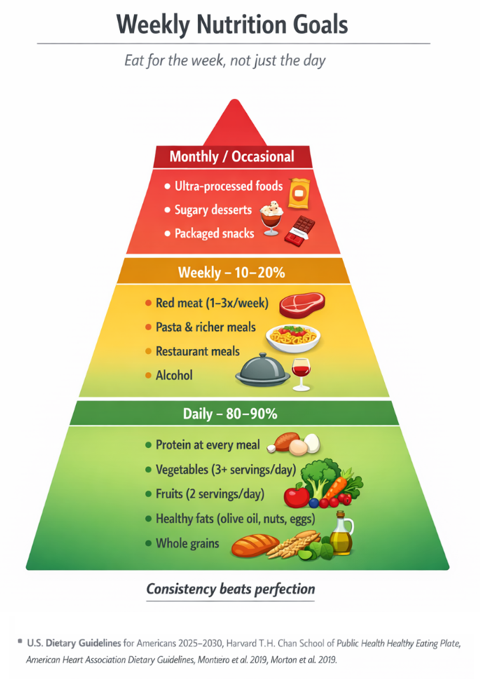 The same applies to richer, more calorie-dense meals. Pasta, creamy dishes, cheese-heavy meals, and restaurant dining are not “off-plan” they’re part of how people actually live. But when they become routine, they start to crowd out simpler, more nutrient-dense meals built around protein and vegetables. A bowl of pasta on a Friday night, pizza with friends, or dinner out can absolutely fit into a healthy pattern. What matters is that these meals are part of the week, not the structure of every day.
Alcohol fits here as well. While the science continues to evolve, the trend is toward more caution at any level of intake. When alcohol becomes a deliberate, occasional choice rather than a daily habit, both frequency and quantity tend to regulate naturally. The goal isn’t to remove foods that are enjoyable or culturally meaningful—it’s to right-size their role. Give them a place, just not the entire stage. That’s what makes this approach sustainable.
What to Save for Monthly: The Reality Check
At the top of the pyramid are foods that are hardest to manage—not because they’re inherently harmful, but because they’re designed to be easy to overconsume. Ultra-processed foods like chips, packaged snacks, sugary drinks, fast food, and desserts are engineered for taste, convenience, and shelf life. Combinations of refined carbs, added fats, salt, and flavor enhancers make them highly palatable, and hard to stop eating.
This is by design. And today, these foods have shifted from occasional treats to daily staples, making up more than half of calorie intake for many Americans. Research consistently links high consumption to increased risk of obesity, type 2 diabetes, cardiovascular disease, and mood disorders. The takeaway isn’t elimination, it’s frequency. When these foods are occasional, cake at a birthday, ice cream on a summer night, chips at a party, they stay what they’re meant to be: enjoyable and social.
But when those same foods become automatic, an afternoon snack every day, dessert every night, processed options at most meals, they stop being treats and start becoming the baseline. And in doing so, they gradually displace the foods that support long-term health.
This is where the distinction becomes important: the difference between a treat and a habit is not the food itself, it’s how often it shows up.
A healthy diet doesn’t look rigid, it looks rhythmic. During the week, meals are simple and repeatable. Protein shows up at every meal. Vegetables are included when possible. Snacks are built from real food. On the weekend, there’s flexibility. A dinner out. A shared dessert. A break from routine.
What to Eat in a Day: A Practical Breakdown
For an average adult, a realistic daily intake might look like this:
A day built around this might include eggs and berries in the morning, a protein-forward lunch with vegetables, and a simple dinner of fish, grains, and greens.
Not perfect. Just consistent.
The new Dietary Guidelines have a message that nutrition science has been moving toward for years:
- Eat whole foods
- Prioritize protein
- Reduce ultra-processed foods
- Limit added sugars
What’s different now is not the message, but the recognition that it must be livable. Because the best diet isn’t the most optimized one. It’s the one you can sustain. Psychologically, rigid rules often lead to burnout, while structured flexibility leads to consistency.
What this looks like in practice for me, a strong week usually starts with a few days of consistency. Monday through Wednesday tend to feel structured, our meals are simple, protein shows up at each one, and I’m making a conscious effort to include vegetables. Nothing elaborate, just a rhythm that works. By Thursday, things often start to shift. Schedules get busier, groceries are running low, and the idea of another round of leftovers feels less appealing. That’s usually when I might open a bottle of wine, or we pivot to something easier, takeout between activities, a quicker dinner, something less planned.
And then the weekend looks different altogether. Breakfast and lunch are wholesome but we might go out to dinner, have a more indulgent meal, or share dessert, something we don’t do every night, but something we actually enjoy when we do. These aren’t failures. They’re part of a full life. The difference is that they don’t define the entire week.
The Bottom Line
You don’t need a perfect day. You need a pattern that works across time: Eat real, nutrient-dense foods most days, build flexibility into your week, save indulgence for moments that matter. The goal isn’t perfection. It’s a way of eating you can sustain for years.
Share this article



Listen to the Dirt to Dinner Podcast