Transcript: The ‘Real Food’ Reset
The Dirt
This is a transcript for the podcast episode, "From Guidelines to Groceries: The Real Food Reset". The new USDA/HHS dietary guidelines marks a “historic reset” in U.S. nutrition policy with a straightforward message: eat real food. But how does this differ from current guidelines?
Nutrition
Podcasts
Transcript: The ‘Real Food’ Reset
The Dirt
This is a transcript for the podcast episode, "From Guidelines to Groceries: The Real Food Reset". The new USDA/HHS dietary guidelines marks a “historic reset” in U.S. nutrition policy with a straightforward message: eat real food. But how does this differ from current guidelines?
Click Play to listen to our generated podcast.
You can also access the original post here and our full podcast library here.
We are diving into the newly released 2025 2030 dietary guidelines from the USDA and HHS. They just dropped on January 7, 2026. And normally I think people hear government guidelines and they just tune out.
Oh yeah. Normally I would say prepare to be bored because it’s usually just endless PDFs about percentages and obscure micronutrients.
Exactly. I just picture the food pyramid that weird triangle from the ‘9s that told us to eat an entire loaf of bread at the bottom.
Right. With a tiny piece of steak at the very top.
Yeah. But this this is different. The sources we’re analyzing are calling this a historic reset.
It’s a huge move away from what you would call nutrition by math. You know, counting calories and percentages and a real pivot toward nutrition by common sense, which sounds fantastic on paper, but as I was reading through this, I realized this isn’t just a friendly suggestion. The government seems, well, panicked.
That is the right word. Urgency is all over this text.
So, our mission today is to figure out why the script has flipped. We need to unpack why the government is suddenly treating your dinner plate like a national security issue.
What the heck happened to lowfat? Because that was a shocker to me and crucially what you are actually supposed to buy when you go to the grocery store now.
Well, we need to talk about the economics too because when the US government changes the menu, it sends these huge shock waves through the entire farming economy.
Okay, so let’s start with that panic. Why the reset? Why now? Was the old advice just not working?
Not working is a very polite way to put it. The source material frames this as a direct response to a catastrophic failure in public health.
So, we’re not just a little unhealthy. We are in a metabolic crisis.
The numbers in here, I had to reread them. I actually thought it was a typo.
They’re staggering. The report notes that nearly 90% of US health care spending now goes toward treating chronic disease.
So, nearly every dollar we spend on doctors and hospitals is just managing ongoing sickness.
90 cents on every dollar. We are effectively bankrupting the system, treating diseases that are for the most part preventable. It’s just unsustainable.
And the weight statistics, more than 70% of American adults are overweight or obese. But the stat that I think really terrified the policy makers, the one that likely forced this reboot, is about the kids. The pre-diabetes stat.
Yes. Nearly one in three adolescents has pre-diabetes.
So that means their bodies are already struggling to handle sugar before they even hit their 20s. That’s terrifying.
It is and the guidelines explicitly state that 60% of these chronic issues are attributed to inflammatory diets.
Okay, can we define that? Inflammation is such a buzzword; everyone uses it. But what does it actually mean in this context?
Think of it like a low-grade fire inside your body. When you eat foods that your body struggles to process, you know, highly-processed stuff, constant sugar spikes, your immune system stays on high alert. So, it never rests.
It’s constantly fighting what it inks is an invader. That chronic irritation damages blood vessels, organs, tissues, everything over time. It’s the engine heat that eventually blows the gasket.
So the government looks at this map of inflammation and says this isn’t just about fitting into your genes anymore.
No, they are framing diet related disease as a national readiness issue.
That sounds like military language.
It is. If your population is too sick to work, too sick to serve in the military, or just too expensive to insure, you don’t have a health problem. You have a national security problem.
So that explains the why. The house is on fire. Now let’s look at the what because they are changing the visuals. I mentioned the food pyramid earlier. That big slab of carbs at the bottom.
For 40 years, the advice was anchor your meal with starch and be very, very careful with fat. And the new guidelines, they completely flipped the script. The new visual anchor is protein, healthy fats, and whole produce.
Okay, let’s tackle protein first because looking at the notes here, they prioritize protein at every meal. That feels aggressive.
It is a dominant strategy and the target numbers are specific: 1.2 to 1.6 g of protein per kilogram of body weight, or roughly 0.5 grams per pound of body weight.
Okay, so if I weigh 160 lbs, I need about 80 grams of protein per day, right? Which doesn’t sound crazy until you actually try to do it, right?
That’s not just an egg for breakfast. That’s like three eggs or a substantial piece of chicken at lunch and dinner. It requires intent.
Why the push for so much? Is everyone supposed to be a bodybuilder now?
Well, there are three reasons the source really highlights. First is muscle maintenance. We are an aging population. If you want to be walking, carrying groceries, and living independently in your 80s, you need muscle mass. You can’t build or keep muscle without adequate protein. It’s basically an anti-frailty prescription.
That makes sense. But what about weight?
That’s the second reason, and it’s the most interesting one for weight loss, satiety, the feeling of being full.
But it’s more than just feeling full. There’s a theory, and the guidelines really lean into this, that your body essentially keeps you hungry until it gets enough protein.
So, it’s like a nutrient hunt.
Exactly. If you eat a bag of chips, you can eat the whole bag because there’s almost no protein. Your body is saying, keep eating. I haven’t found the building blocks yet. But if you eat a steak or a large serving of lentils, your body signals, okay, we got the goods. You can stop.
That that explains so much about my late night snacking. So, if I prioritize protein, I’m kind of hacking my own hunger signals.
Precisely. It crowds out the junk. If you fill up on the protein, you just naturally eat fewer calories overall without having to count them.
And the third reason, it’s cultural. It’s hard to teach people about complex versus simple carbs. But everyone knows what a piece of chicken is. It’s a clear message.
But I have to play devil’s advocate here. I feel like I see headlines every other week saying too much protein kills your kidneys or Americans eat too much meat. Is this universally accepted?
No. And the source acknowledges that tension. There is a counterview. Some nutritionists argue that most Americans already get plenty of protein and we don’t need to push it higher. But the guidelines committee made a choice. They decided that the risk of obesity, diabetes, and frailty was much higher and much more urgent than the hypothetical risks of eating too many pork chops. They’re betting on protein to fix the metabolic crisis.
Okay, so we’re eating the pork chop now. What do we cook it in? Because this is the part that actually shocked me. I grew up in the skim milk era. I thought fat was the enemy.
This is the aha moment of the whole document. The guidelines have done a complete 180 degree turn on dairy. They’re actually endorsing full fat dairy explicitly. Whole milk, full fat yogurt, cheese…as long as — and this is the key — it has no added sugar.
I feel like I need a moment of silence for all the watery skim milk I drank in the ’90s. It was bluish. It was so sad.
It was a sad time for cereal. Yes.
But seriously, how did we get this so wrong? For decades, doctors told us saturated fat in milk would give us heart attacks.
Well, you have to look at the history. In the 1950s, there was this hypothesis that dietary fat equaled body fat and heart disease. It was simple. It seemed logical. But it was wrong.
And we know this for sure now.
The source notes that research since at least 2002 has shown that the fat and dairy is just not the villain we thought it was.
So why is full fat better? Is it just because it’s less processed?
It’s about something called the food matrix. Nature packages things together for a reason. Vitamins A, D, E, and K are fat soluble. You literally cannot absorb them without fat.
So if you drink skim milk, then you’re just flushing those vitamins away. You need a ‘fat taxi’ to get them into your system.
And I’m guessing the satiety factor comes back into play here.
It’s a huge factor. Fat signals to your brain that you are fed. It slows down digestion. But there’s a sneakier reason the government is pushing this. Think about what happens when you take the fat out of yogurt. What does it taste like?
Chalk. Sour chalk.
Exactly. So, what did the food companies do to make us eat it?
They dumped sugar in it, fruit on the bottom, which was basically just jam.
Right. So, The low-fat craze actually fueled the sugar craze. By embracing full fat, the guidelines are trying to break that cycle. If the food tastes good naturally, because fat carries flavor, you don’t need to sweeten it.
And this isn’t just advice, right? This is actually changing laws.
It is. The source mentions the Whole Milk for Healthy Kids Act, which was signed just after the guidelines on January 14th, 2026.
So whole milk is actually back in schools.
Correct. The era of mandatory skim milk in the cafeteria is is over.
That is a massive shift. It really signals that we aren’t scared of healthy fats anymore.
We aren’t. And it extends beyond dairy. The guidelines are pushing for avocados, nuts, olive oil, eggs. The whole idea is to replace the calories we used to get from refined carbs with calories from healthy fats.
Which brings us to the common enemy. If we are eating steak and drinking whole milk, what are we cutting? Because we can’t just add calories on top of everything.
We are cutting the refined carbohydrates: the white bread, the crackers, the pastries, the white rice,
the stuff that makes life worth living.
Unfortunately, yes, but also the stuff that spikes your blood sugar the fastest.
The advice here is eat the rainbow, which I’ve heard since kindergarten, but there’s a nuance in the new text about whole forms.
Yes, the goal is five to seven servings of fruits and veggies a day, but they are really cracking down on juice.
Juice is well, it’s been demoted.
Metabolically, drinking a glass of orange juice is very similar to drinking a soda. You get all the sugar instantly with none of the fiber to slow it down. The guidelines want you to eat the orange. The fiber acts like a break on the sugar absorption.
So fiber is the buffer.
Exactly. It changes the hormonal response completely.
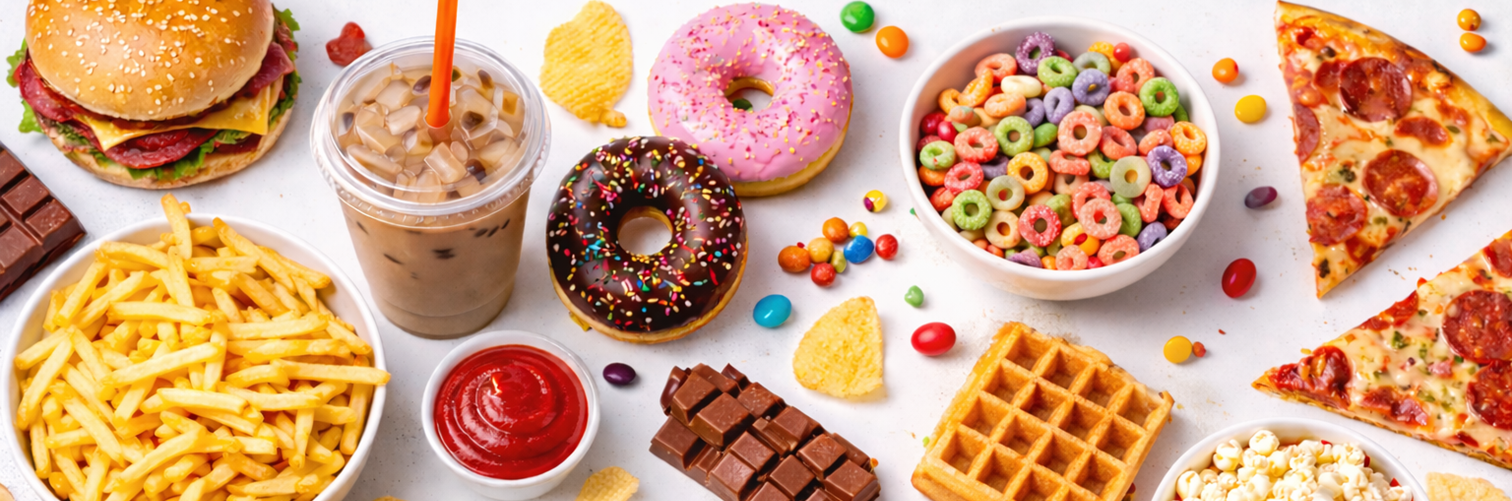
Okay. So we have the good list: protein, healthy fat, whole plants. We have the bad list: refined carbs. But what about the buzzword of the decade? Ultra-processed foods, UPFs. Is the government finally banning the Dorito?
This is where it gets politically tricky. The source notes that the term UPF isn’t splashed across the document in big red letters. They don’t want to get sued by every food company in America. But they’re being subtle about it.
They’re being descriptive. Instead of saying don’t eat UPFs, they say limit foods with artificial additives, stabilizers, and high added sugar. They’re describing the wrapper without naming the brand.
It’s the if it has ingredients you can’t pronounce, don’t eat it rule.
Precisely. They’re targeting the hyper-palatability. It’s when a food is engineered to be so delicious, the perfect crunch, perfect salt, perfect sweet that your brain’s stop signal just gets overwritten.
You can’t eat just one, right? The guidelines are trying to steer us back to, you know, boring food that our bodies actually know how to regulate.
This all sounds great. It really does. I love the idea of real food, but I have to bring up the implementation problem. The source brings this up, too. Real food is expensive, it spoils, it takes time to cook…
This is the real-world reality check. It is incredibly easy for a podcast host to say just roast a chicken,
right? It’s very hard for a single parent working two jobs to find the time or money to do that.
So, does the government have an answer for that or are they just shaming people who rely on boxed mac and cheese?
Well, HHS is trying to be practical. They’ve explicitly expanded the definition of healthy to include canned, frozen, and dried options.
So, frozen broccoli is okay. Not just okay, encouraged. Canned beans, frozen spinach, tinned tuna. These are shelf stable. They’re affordable and they’re nutritious. They are trying to break the myth that healthy requires a boutique grocery store and a private chef.
That’s a crucial distinction. You don’t need the organic kale massaged by monks. You just need the frozen peas. Exactly. It’s about access, not perfection.
I want to pivot to the invisible machinery behind this. You mentioned farmers earlier. If everyone in America actually followed this advice tomorrow…if we all started eating 80 grams of protein and drinking whole milk, what happens to the economy?
The guidelines act as a demand signal. Farmers plant what they think people are going to buy.
So, this is good news for cattle ranchers and dairy farmers.
Massive news for the dairy industry. This is a reputational resurrection. After being the bad guy for 40 years, they just got a federal seal of approval. That changes marketing. It changes subsidies. It changes everything.
But what about the companies making the frankenfood, the processed stuff? Are they just going to fold?
Oh, they’re smart. They’ll adapt. The source predicts a boom in minimally processed, value-added foods.
That sounds like business jargon. Translate.
Think of a rotisserie chicken. It’s convenient. It’s prepared, but it’s just a chicken. Or a bag of chopped salad kit with a simple dressing. Food that is easy but real. The money is going to shift from making new fake foods to making real foods easier to eat.
So, less science experiment and more convenience.
That’s the hope. The market follows the money, and if the money is chasing protein and real ingredients, the companies will provide it.
It really feels like we’re closing a chapter. We spent 50 years doing nutrition by the numbers, fearing fat, swapping butter for margarine, and we just got sicker and fatter. This feels like a return to grandmother wisdom.
It’s a simplified northstar. It’s admitting that we can’t outsmart millions of years of biology with a calculator. We tried to engineer a better diet and we failed. Now we’re going going back to basics.
So, if you’re standing in the grocery store right now feeling overwhelmed by all the labels, what’s the cheat sheet? How do we recap this reset?
Ideally, you remember four things. One, prioritize protein. Aim for that 0.5 gram per pound. It’s the anchor. It builds the muscle and kills the hunger. Two, don’t fear the fat. If it’s natural, like from dairy, nuts, or avocados, eat it. It keeps you full and helps you absorb vitamins. Three, eat the rainbow. Don’t drink juice; fiber is your friend. And four, ignore the marketing on the front of the box; turn it over. If the ingredient list looks like a chemistry textbook, put it back.
Simple, effective, and hopefully delicious. But before we let you go, I have one final thought I want to leave everyone with. Can a policy document actually change what is on the shelves, or is that entirely up to us, the consumers, to demand it with our wallets?
History shows the consumer moves first, the market follows. If we stop buying the junk, they will eventually stop making it.
Something to chew on, preferably over a high protein dinner. Thanks for listening to this deep dive. Go eat some real food and we’ll catch you next time.
Stay tuned for our next episode!
Are you a farmer or food & ag expert? Or do you know someone in the industry who would consider an interview on our "Digging In" podcast? Reach out to us at connect@dirt-to-dinner.com!
Share this article



Listen to the Dirt to Dinner Podcast