Why October’s Diesel Squeeze Matters
The Dirt
Many of us may not know it, but a diesel engine powers almost every step of our supply chain...and we certainly feel it right now, as prices for our goods continue to increase. From bombed-out refineries in the Persian Gulf and Russia to the combine harvesting corn in Iowa, energy policy is food policy. Until global refining capacity comes back online, the hidden ingredient in your grocery cart this fall will continue to be the increasing cost of diesel.
Global Food
Why October’s Diesel Squeeze Matters
The Dirt
Many of us may not know it, but a diesel engine powers almost every step of our supply chain...and we certainly feel it right now, as prices for our goods continue to increase. From bombed-out refineries in the Persian Gulf and Russia to the combine harvesting corn in Iowa, energy policy is food policy. Until global refining capacity comes back online, the hidden ingredient in your grocery cart this fall will continue to be the increasing cost of diesel.
At Dirt to Dinner, we often talk about soil health, seeds, and science-backed nutrition. But today, we need to talk about a completely different kind of input—one that is currently stressing the global food system: diesel fuel.
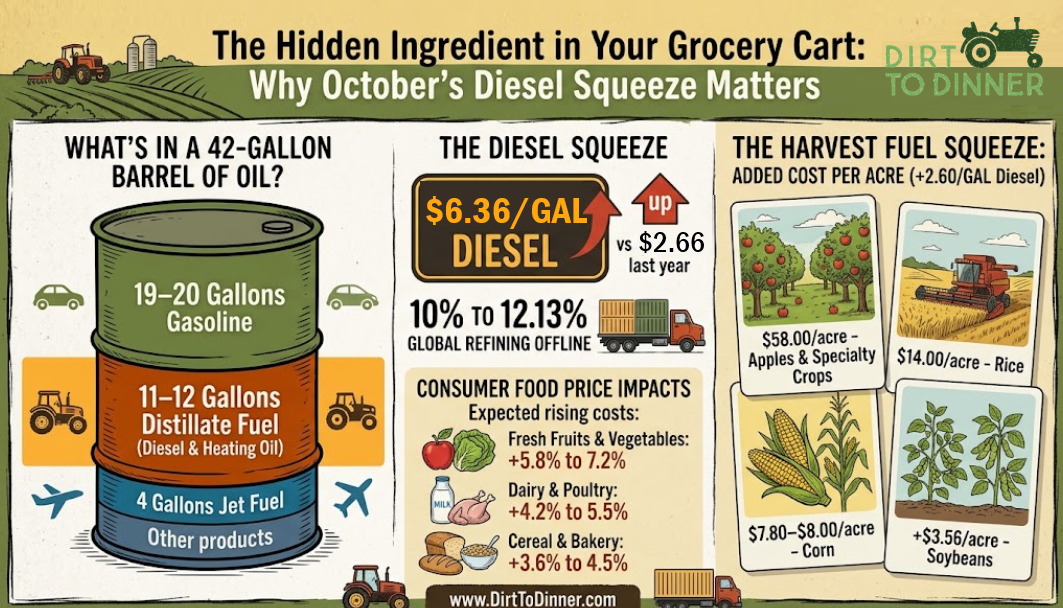
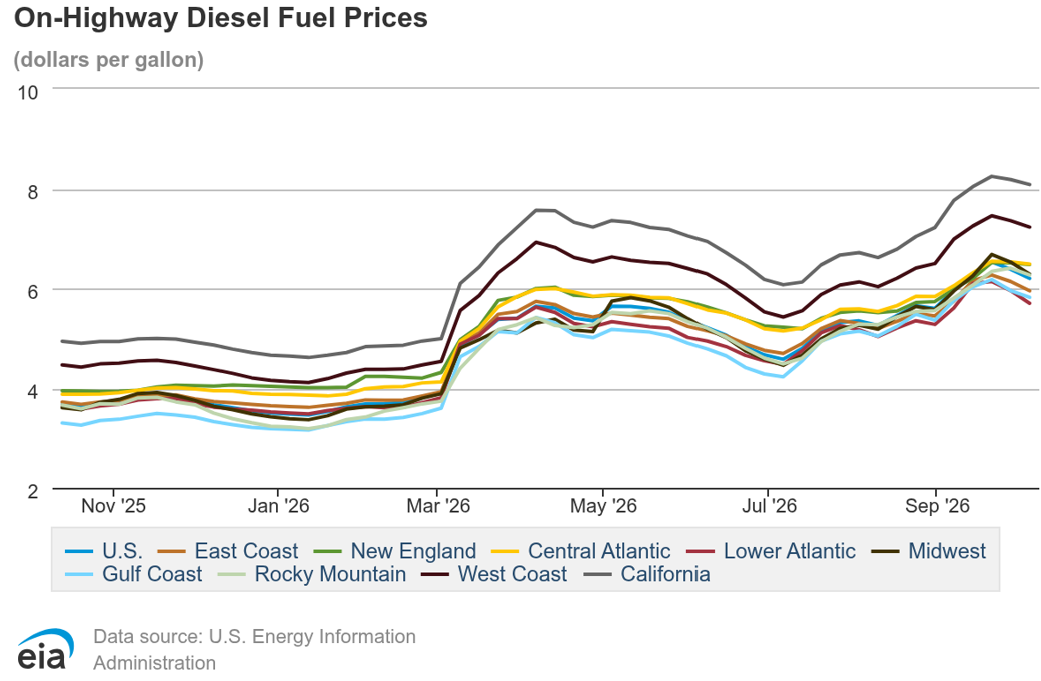
As of this writing, a gallon of retail highway diesel sits at approximately $6.36, compared to $2.66 just a year ago. What does this have to do with food? Because a diesel engine powers almost every step of our supply chain—delivering your Amazon packages, hauling your clothing, and, most importantly, harvesting and transporting your food.
Here is what is happening in the global energy market right now, and why it matters for your grocery bill this fall.
What you need to know:
- Global oil refining capacity has declined by at least 10%, forcing a 133% increase of US diesel prices, which increases the cost of food.
- The Russian/Ukraine war and Iran retaliation is the main cause. As of this writing, there does not seem to be a solution to Ukrainian / Russia cease fire on refineries. Or the Strait of Hormuz.
- Asia Pacific and India are building super refineries to bring more capacity online by 2030.
What This Means for Your Dinner
Food inflation isn’t just about grocery store markups; it is fundamentally about logistics.
When it costs a farmer significantly more to run a combine, and it costs a trucker nearly twice as much to haul a refrigerated trailer across the country, those costs compound at every link in the chain—from ocean freighters and river barges to long-haul semi-trucks and local delivery vans. Refueling a standard 750-gallon farm fuel truck costs about $1,995 more.
In the United States, trucks move roughly 83% of all agricultural products and 92% of dairy, fruit, vegetables, and nuts. When global refining capacity is compromised by simultaneous wars in Eastern Europe and the Middle East, it directly hits your kitchen table.
The next time you bite into a crisp fall apple, remember the incredible—and currently very expensive—journey it took to get from the orchard to your table.
The Global Squeeze: When Refineries Go Offline
Who would have thought that the biggest economic conversation this fall wouldn’t be about the price of crude oil, but about refineries?
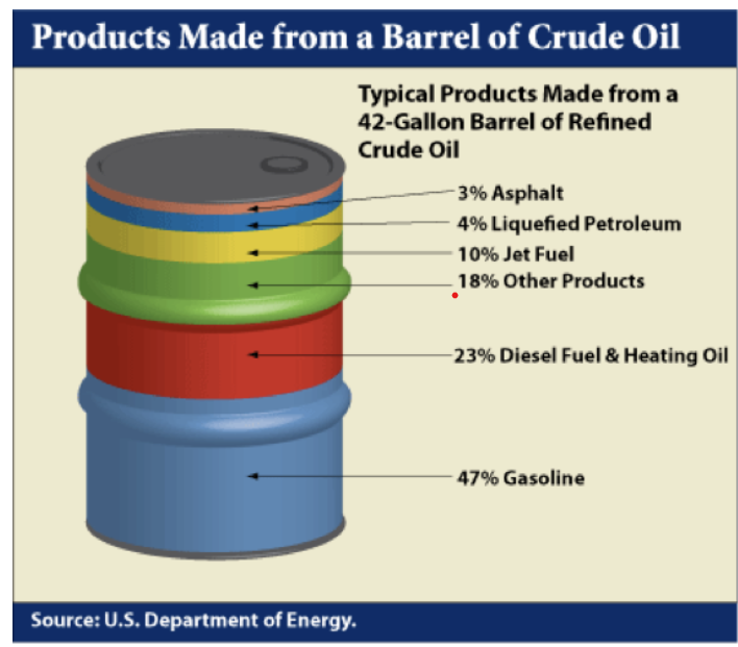
While global crude oil prices have hovered around $100 a barrel, the facilities that refine that raw crude into usable fuels are in severe short supply.
Every 42-gallon barrel of crude oil is refined into roughly half a dozen core products, yielding about 19–20 gallons of gasoline, 11–12 gallons of distillate fuel (diesel and heating oil), 4 gallons of jet fuel, alongside liquefied petroleum gases, heavy ship fuels, and asphalt.
Right now, between 10% and 12.13% of total global refining capacity is offline, driven by two major geopolitical conflicts:
1. The Ukraine–Russia Refinery War & Sanctions Whiplash
Ukraine has sustained a relentless deep-strike drone campaign against Russian refining infrastructure, striking Russian oil facilities over 300 times since 2022, with vastly heavier and more accurate attacks throughout 2025 and 2026. At peak disruption, Ukrainian drones knocked out roughly 38% of Russia’s operational refining capacity (with temporary disruptions touching 51%).
Up until recently, hopes remained for a negotiated energy cease-fire that would halt bombings on refineries and power grids. Instead, diplomacy and pressure for mid-term elections collided with the diesel crunch
- The Lindsey Graham Sanctions Bill: In September, Congress passed and President Trump signed the Lindsey O. Graham Sanctioning Russia and Iran Act of 2026, which authorized 100% secondary tariffs on any country (such as India or China) importing Russian oil.
- The 36-Million-Barrel Pivot: Facing a brutal domestic diesel shortage at home, the Trump administration pivoted on October 9th—announcing a deal to allow 36 million barrels of Russian diesel back onto U.S. and global markets and subsequently signing an executive order waiving enforcement of the Graham bill’s sanctions until April 2027.
- Zelenskyy’s Response: Calling the U.S.–Russia diesel waiver an “investment in war,” Ukrainian President Volodymyr Zelenskyy rejected calls for an energy cease-fire and vowed to continue deep strikes against Russian refineries. Which he has.
2. The U.S.–Iran Conflict & Middle East Bombings
We tend to think of the Middle East strictly as a source of 30% of the world’s oil, but the region also houses roughly 11% to 12% of the world’s refining capacity—including some of the newest, largest diesel-exporting mega-refineries on Earth.
Following the U.S. offensive against Iran that began in February 2026—where airstrikes and sabotage sparked fires and heavily damaged three major Iranian refineries—Tehran struck back across the Persian Gulf. Iranian drone and missile barrages hit vital oil and refining complexes across Saudi Arabia, Kuwait, the UAE, Bahrain, and Qatar, knocking out roughly 25% to 30% of the Gulf’s refining output (up to 3 million barrels per day of Middle Eastern refining capacity remains offline).
The Strait of Hormuz squeeze and closure shows the volatility of shipping costs. Let’s use the cost of Very Large Crude Carrier (VLCC) from the Middle East Gulf Coast to Asia. These ships are just longer than three football fields and carry global crude oil around the world. Before the war with Iran, the cost of a VLCC voyage was between $8 million and $14 million.
In February/March, rates ran up to new, unheard-of highs of between $18 million and $25 million. In October, the cost was even higher to an unbelievable $80 million. As of October 19, it has settled down to $65 million. That is still $50 million more than before the war. The cost is the same from the U.S. Gulf Coast – $81 million.
The Policy Scramble
With global supplies choked off, the United States had been stepping in to supply Europe. That strain pushed U.S. off-road farm diesel prices higher.
Policymakers are now scrambling to contain the fallout:
- Emergency Reserve Releases: In Europe and across the G7, nations are coordinating an emergency release of 50 million to 100 million barrels of petroleum product reserves, including 20 million barrels of diesel.
- Suspending the Federal Diesel Tax: Amid heated debates over whether to ban U.S. diesel exports altogether, President Trump signed Executive Order 14435 on October 5th. The order suspends penalties for using “red-dyed” off-road farm diesel on public highways effectively waving the 24.4 cents-per-gallon federal diesel tax through December 31st to give farmers and truckers immediate relief.
- The Russian Supply Band-Aid: In 2025, Russian exports were about 3% of global consumption and 10% of total trade. Ukrainian attacks on the refineries caused a deficit in their local diesel market. In July, Putin placed a ban on diesel exports. On October 9th, to keep prices down, Trump and Putin agreed to increase Russian diesel exports to global markets and the United States. In turn, Trump will suspend sanctions on anyone who purchases Russian diesel.
While the White House’s October 9th deal to purchase 36 million barrels of Russian diesel made geopolitical shockwaves, it is only a temporary cushion. The U.S. consumes approximately 3.9 million barrels of diesel per day—meaning 36 million barrels represents just over 9 days of American diesel demand (or less than 8 days of global seaborne trade).
The real solution is to end war with Iran so oil from Kuwait, Saudi Arabia, and the UAE could fill in the void.
The Farm-Level Reality: Harvest Gets Expensive
To understand how this hits your wallet, look at what is happening in American fields right now. October is still harvest season. Tractors, combines, grain carts, and transport trucks are running around the clock—and every single one runs on diesel.
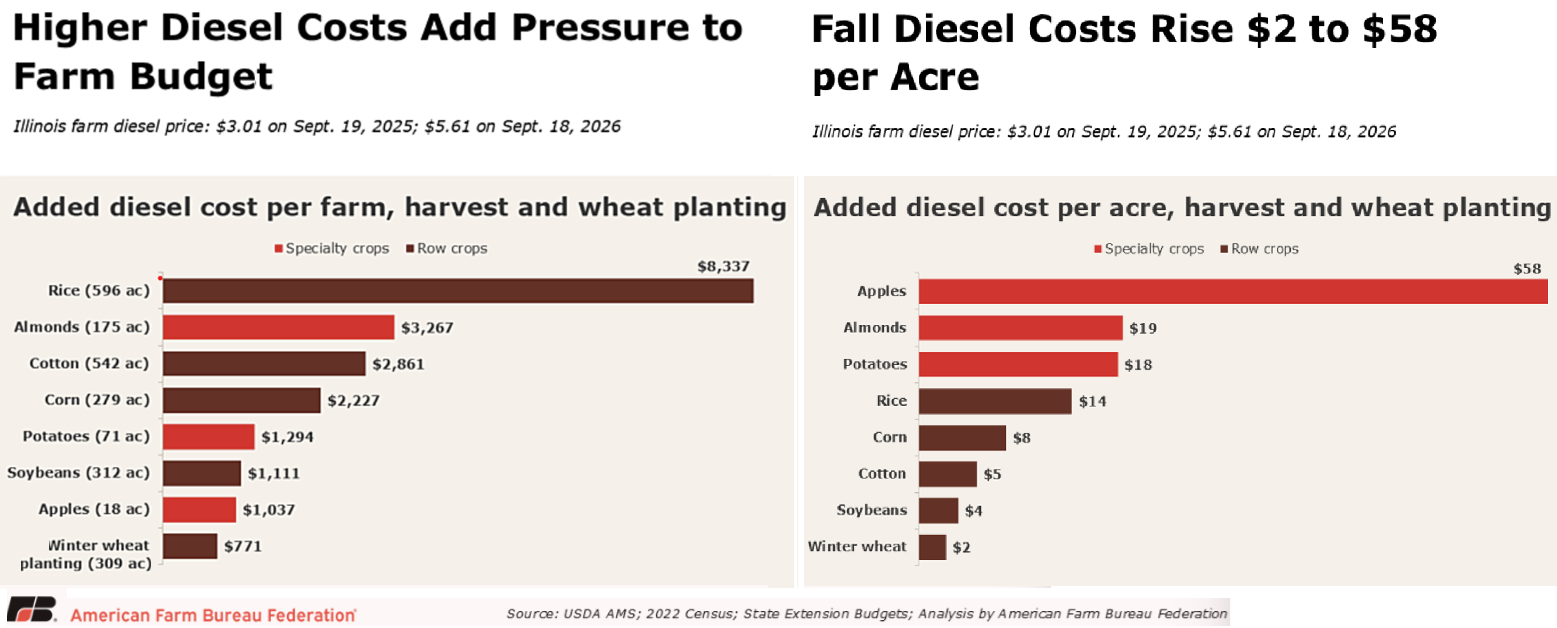
When farm diesel jumps 86% (a $2.60 per gallon increase), the cost of pulling food out of the ground skyrockets. According to estimates from the American Farm Bureau Federation, this autumn’s diesel surge is adding steep per-acre penalties across major crops:
The Biofuel Play
To make up for the petroleum distillate deficit, U.S. refiners are aggressively buying up domestic soybean oil to blend into “renewable diesel” and biodiesel to keep trucks moving. U.S. soybean crush volumes recently hit a staggering 17.8 billion pounds.
The Bottom Line
Diesel prices will continue to remain high until geopolitical unrest starts to settle. In the meantime, India, China and parts of Asia are building mega-refineries to lesson the strain on Russian and Middle East refineries.
Share this article



Listen to the Dirt to Dinner Podcast