The Shocking Scale of Global Crops
The Dirt
Winter doldrums have triggered another letter from our intrepid reporter in the Carolina hills. Put down your calculators and get ready for this less-than-academic reflections on current conditions in our global agricultural marketplace. Just how much are we really producing of the corn and soybeans on which our food system is built? How do we understand the sheer scale of modern commodity production, even without an advanced degree in agricultural economics?
Global Food
The Shocking Scale of Global Crops
The Dirt
Winter doldrums have triggered another letter from our intrepid reporter in the Carolina hills. Put down your calculators and get ready for this less-than-academic reflections on current conditions in our global agricultural marketplace. Just how much are we really producing of the corn and soybeans on which our food system is built? How do we understand the sheer scale of modern commodity production, even without an advanced degree in agricultural economics?
To My Dirt to Dinner readers:
Combine a dank, cold winter with an aging, housebound man, and you most likely will see some odd behavior. Some very odd behavior.
In my case, that behavior is a reversion to an old, old habit, ingrained in me over many long years of following agriculture. God help me, but I actually read some of the reports and studies produced by our government about different aspects of our food system.
Well, somebody has to do it. Otherwise, we’re wasting an awful lot of tax dollars.
Our marvelous Department of Agriculture produces some amazing reports, based upon reams and reams of data its minions collect regularly. People like me actually look forward to seeing many of them. They keep nerds comme moi occupied and up to date on how much food we produce, how much we sell, how much we store, and so on. They help us see how we’re doing in providing the food security that we all want.
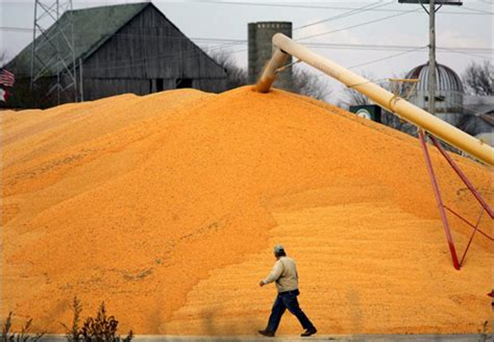
Mostly, the reports and data tell us we’re doing a pretty darn good job of producing enough food to feed the 8.3 billion people walking the earth today. Maybe that’s all the average person really needs to know from the USDA reports. Maybe that, and a subtle reminder about the incredible productivity and commitment of farmers and ranchers here in the United States – and around the world, for that matter.
I won’t bore you, my loyal readers, with another of my dry, dusty deep dives into planted acreage, base acres, yield trends, reserve stocks and on and on and on. But when USDA’s Global Production Report hit the streets a few days back, it struck me that we might sit back as Average Joes and Janes and just marvel at the reality behind those incredible numbers.
Serious students of agriculture today talk at length about the abundance of grains and oilseeds, here in the United States and on a global scale. And well they should. We’re reaping the benefits – and the costs – that come from farmers and ranchers doing their jobs all too well.
The latest USDA report, for example, puts 2025-26 projected global corn production at an astounding 1,295 million metric tons. The United States alone accounts for 432 million metric tons. USDA’s report confirms that we continue to see record crop after record crop in recent years.
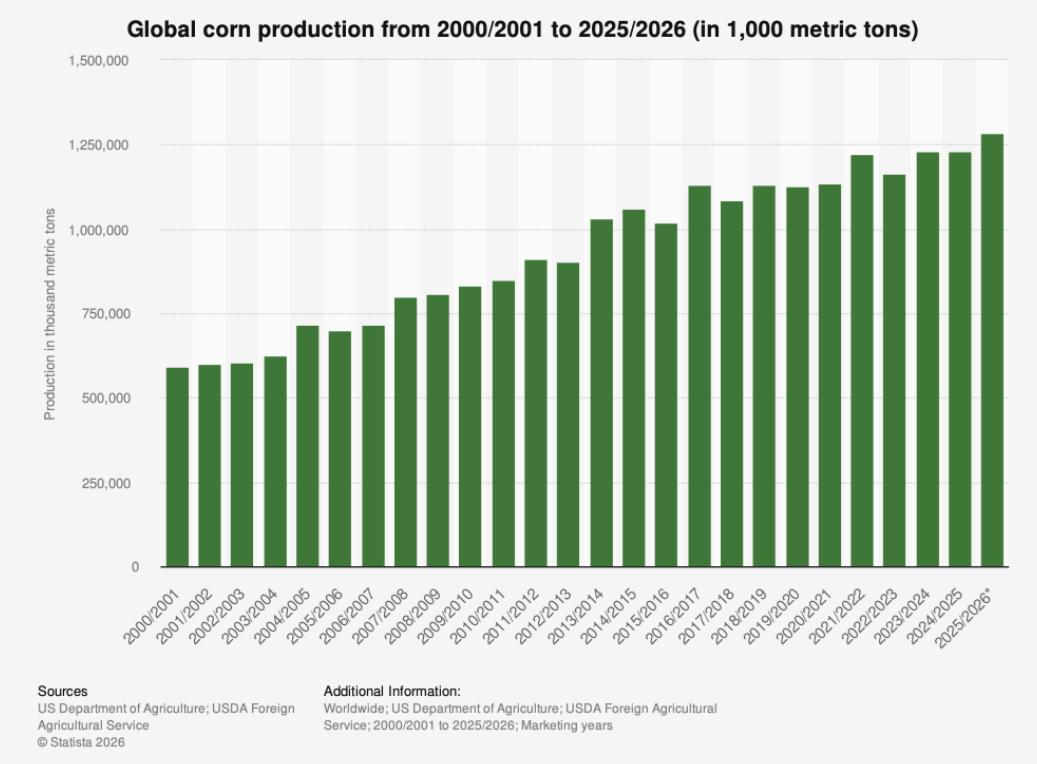
Why do we grow so much? Because we need it.
Sounds like great news, right? After all, corn is a cornerstone commodity – a crop absolutely essential to our modern food system. Corn also contributes to our energy needs as a key stock in ethanol production. It even winds up in things made of plastic and the cosmetics that keep me looking good even into my 70s.
But by far and away, corn is vital to feeding humans and animals. These veritable mountains of grain and oilseeds mostly go into feeding the 227 pounds of red meat and poultry each American eats every single year. Just in the U.S. alone, we process approximately 32 million cattle, 9 billion chickens, and 140 million hogs. And around the world, 40% of both U.S. corn and soybeans get exported to feed the 1.5 billion pigs, 332 million cattle, and 74 billion chickens. These figures don’t even account for the additional amounts required to feed the chicks, calves, and piglets until they are fully grown.
Ditto for soybeans. As our nation’s most valuable agricultural crop, soybeans provide the foundation for countless animal feeds and a host of human food products. Soybean meal is highly sought after around the world to feed expanding animal herds and flocks. Soybean oil is a cooking staple. Soy milk and tofu depend upon the humble soybean to even exist. And like their corn brothers and sisters, soybean farmers help provide key stocks for biodiesel, plastics and a multitude of other purposes.
It’s little wonder, then, that we see a global soybean crop for 2025-25 of nearly 427 million metric tons. Brazil will contribute about 180 million metric tons of that total. The United States will kick in another 116 million metric tons. Yes, that also is another record year of global production. The world needs the humble soybean, and farmers almost everywhere are anxious to provide them.
But when does too much of a good thing become a problem? Ask any corn farmer today for an answer.
When supplies exceed demand, economic trouble follows close behind. USDA makes one point abundantly clear – we are awash in some of our most important cornerstone commodities, like corn and soybeans.
Because of oversupply, farmers have to fight ever harder for foreign markets, often against intense and growing competition from other farmers around the world. Energy policies become ever more important. Government assistance in any and all forms begins to play a role in market dynamics. For many, off-farm income becomes an increasingly important part of economic survival.
In farming circles, there’s an old, old saying: the cure for low prices is low prices.
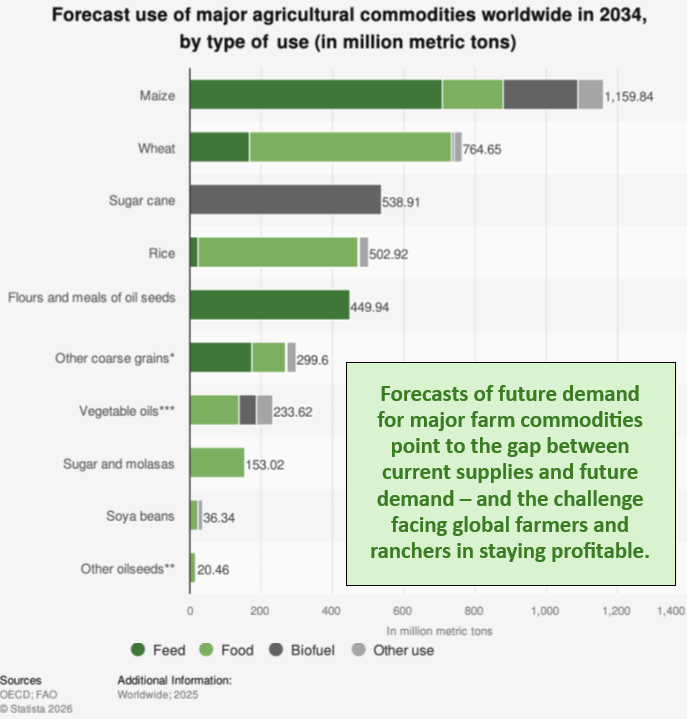 That is, if the price available in the marketplace falls too far, farmers turn to other crops, helping restore a closer balance in supply and demand over time. The same government and private market outlook reports talk optimistically of a tightening in corn markets, as hungry countries such as China and prosperous Asian nations step up imports of corn and other key commodities.
But the follow-up question remains critical within the farming community, too: When? How long before that balance is restored, and how do I survive economically in the meanwhile? After all, Brazil and other highly productive nations are competing aggressively to capture any growth in demand. My banker apparently doesn’t speak Spanish. Manana doesn’t seem to satisfy him when he asks for my operating loan payment.
That’s enough half-way serious thinking in agro-economics. The point is, the over-supply issue is one big, big reason why so many in the agricultural community continue to pay such close attention to the USDA reports. We’re all looking for signs that some kind of balance in supply and demand is emerging…that there’s real and timely hope somewhere down the road for the stronger prices farmers need to remain profitable. Profits are essential if farmers are to stay in the business of providing us with the food (and energy and other consumer products) we need every day.
Agricultural data in gee-whiz terms
To appreciate just how serious all this is, let’s stick with corn as an example of just how big the numbers really are. The numbers all strike me as what I call “gee whiz” facts – simple information, expressed in genuine, everyday language, that gets my attention and makes me stop and think, even for just a moment, about what those numbers really are trying to tell me.
What does 1.3 billion metric tons of corn actually look like? How do I begin to grasp the enormity of the number?
Fans of Mike Myers and the Austin Powers movies probably would be more inclined to look at those numbers for “S & G” purposes. If you get that, enough said. If you don’t, just move on anyway to what follows. Let’s call it: Fun With Corn.
Just how much corn is 1.295 billion metric tons?
Okay, buckle up for the answer to that question. It will boggle anyone’s mind. After all, feeding and supplying essential products to a world of humans and animals is big, big job.
 Imagine the largest structure you can. I immediately thought of the old Louisiana Superdome (now Caesar’s Superdome) – at 3.3 million cubic feet, the largest domed structure in the world. It boasts a diameter of 680 feet – or more that two football fields.
Now the math, simplified. A metric ton of corn is about 40 cubic feet. (Okay, 39.37 for you pedantics.) That means it would take 83,820 metric tons of corn to fill the Superdome. So, we would need about 5,000 Superdomes (okay, 5,183) just to store U.S. corn production…and 15,460 Superdomes to store the world’s annual corn production.
Now let’s take it down to the agriculture world.
A typical on-farm storage silo can hold up to 4,000 tons, although most probably would be a good bit smaller. Mason City, Iowa, boasts a behemoth grain bin 156 feet high and 165 across, holding 2.2 million bushels, or 55,800 metric tons of corn. Its builders call it the largest grain bin in the world.
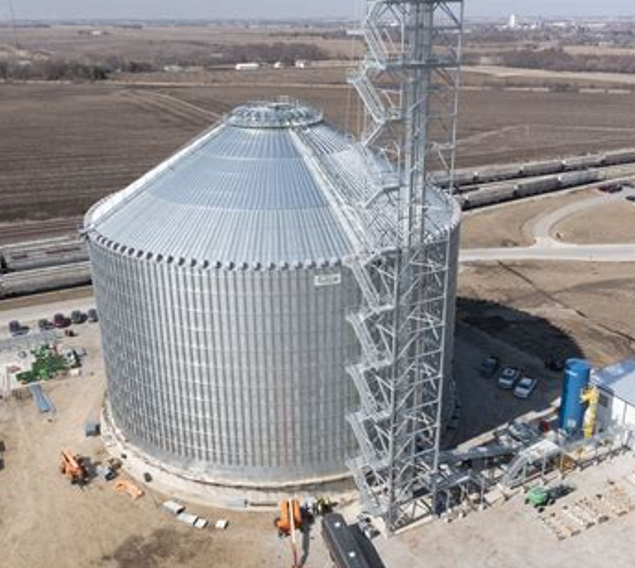
Again, do the math. We would need about 7,750 of these giant facilities to hold the U.S. corn crop – and over 23,000 to hold the global corn crop.
Or think about the ships needed to handle just the amount of the corn crop that the United States exports.
We’re on track to export a record 83.5 million metric tons of U.S. corn in the coming marketing year, or about 20 percent of total production.
Panamax class ocean-going vessels carry 60,000 to 80,000 deadweight tons. Even assuming we use the top end figure, we would need over 1,000 such vessels to handle U.S. corn exports alone. The average Panamax class vessel will be a touch under 1,000 feet long (965 feet), so the nose-to-tail line of the vessels needed to handle all U.S. corn exports would stretch almost 190 miles – the distance from Los Angeles to Las Vegas.
Gee whiz.

How much corn is that per person?
Now let’s get personal. Imagine you suddenly had all your share of the corn crop delivered to your front door. The math says every American man, woman and child would have an equal share of the U.S corn crop of 1.242 metric tons, or roughly 40 bushels, equal to 2,240 pounds in weight.
 Imagine Grandma dragging her ton of corn off the front porch and into the house.
What could you do with it? You could use it for food, or maybe some other household purpose. But you can eat only so much corn on the cob or creamed corn before growing very, very tired of it. And besides, the vast majority of our corn is feed corn, not food corn.
So the better option might be to sell it and save the money, or use it to buy something you really want.
USDA places the farm-gate price for corn at $4.10 per bushel. So what do you want to do with your $164, if you sell? Maybe 56 gallons of regular gas? Or 25 pounds of hamburger? How about three weighted hula hoops for exercise, and a low-fat latte to go with them? It’s your call.
How many different ways is corn used?
Other than food and feed, how do I use corn every day? Or do I simply leave well enough alone and allow corn to work its wonders for my life on its own?
God bless the fine people at the Nebraska Corn Board. They have compiled an amazing list of various ways corn is used today. Marvel at just some of them:
- Toilet paper
- Drywall
- Toothpaste
- Crayons
- Diapers
- Spark plugs *
- Hand soap & sanitizer
- Aspirin
- Rubber tires
- Fireworks
* Corn has a high melting point, making it possible to fashion it into a ceramic-like material that insulates spark plugs from intense heat. Who knew?
Corn is money – really.
References to corn as a form of currency or barter date far, far back – even to The Bible.
“Corn money” has been a common term used to describe the use of corn as a unit of currency – a mechanism for buying and selling goods. Why? Because in early, largely agrarian-based societies, corn was common and universally used and valued. Modern commodity exchanges essentially continue the association – providing an updated value for corn and other commodities important to society.
But in today’s modern world, cash and credit cards have proven to be easier to carry around than sacks of corn.

Why do we call things “corny”?
Merriam Webster defines “corny” first as “mawkishly old-fashioned; tiresome, simple and sentimental. The word in connection with actual corn is a secondary meaning.
The etymology of corny is described as follows:
- It’s been a term of derision only since the 1930s, when something that was “corny” or “cornfed” or “on the cob” was rustic, countrified, old-fashioned, or behind the times – and hence trite or hackneyed.
- It first was used by jazz musicians, who called a style of playing “corny” if it was outmoded or worn out.
See if that doesn’t make you also wonder about how and why we use the word “cheesy.” Maybe if it stays cold and rainy, I’ll make that the subject of my next letter.
By the way, feel free to send me your favorite corny joke. I use ‘em all the time and always look for new ones.
The Bottom Line
Readers, I need your help. You can see what being shut indoors in the cold and dark can do to my mind. Let’s just focus on helping our readers understand the amazing scale and scope of our modern food system – and just how important our food and agricultural system is to the quality of life we all enjoy.
Share this article



Listen to the Dirt to Dinner Podcast