Source for image: United24 Media
Farm Labor Shortages Continue
The Dirt
Actual and potential labor shortages remain a headache for farmers and others in our food system. Technology is stepping in to help deal with it – and in the process stands to boost efficiency and productivity across the entire food chain.
Global Food
Farm Labor Shortages Continue
The Dirt
Actual and potential labor shortages remain a headache for farmers and others in our food system. Technology is stepping in to help deal with it – and in the process stands to boost efficiency and productivity across the entire food chain.
What’s one of the most important farm inputs? Not just seeds and fertilizer, or herbicides and pesticides.
It’s good old labor – the availability of help to do the seemingly endless list of chores that come with farming.
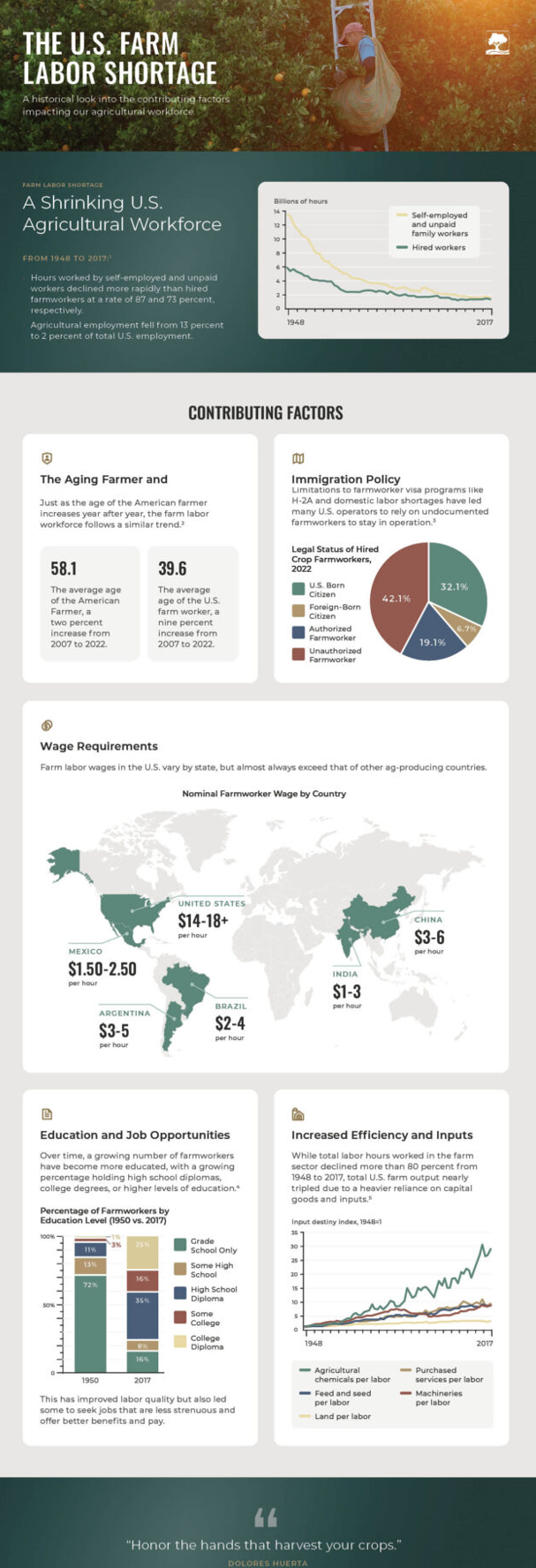 In recent years, farmers have spoken at length of their growing worry over a lack of willing and available workers to make sure all those pesky tasks are done…and done well.
That worry is still there, and justifiably, as the numbers clearly show. But as is ever the case, the farming community is responding to the challenge. How? By making modern technology work even harder to help alleviate the labor headache.
What was initially thought to be the province of industrial factories, warehousing, and shipping has quietly moved outdoors – to the farm field and other points along the food chain from dirt to dinner.
Technology – whether referred to as automation, drones, robotics, and artificial intelligence (AI) – is stepping in to take on more of the routine and not-so-routine aspects of farming and food production.
Technology can do more and more of the rote tasks associated with planting, tending to crops, harvesting, sorting, and many, many other farm jobs.
But it also is a new approach to farming that makes farm fields more than dirt.
It transforms them into living databases – full of potential insights leading to better decision-making. Greater efficiency and productivity. Enhanced income opportunity. Better protection of resources for a sustainable farming future.
The Farm Labor Conundrum
The farm labor problem has many facets. It involves not just a shortage of available workers to do the countless physical tasks of growing and delivering our food. It also reflects worries about shifting demographics and political considerations.
Fewer people seem to want to work as farm laborers. Those who do are aging, with many electing to exit that work force. To add to the complications, our food system is highly dependent upon immigrants – legal and illegal – to do much of this important work. Additionally, growing use of technology has helped serve some of the demand for many jobs, or eliminated them altogether.
There were an estimated 2.4 million open agricultural jobs in the United States in 2024, with 56% of farmers reporting labor shortages, according to FTI Consulting’s June 2025 report.
And the Bureau of Labor Statistics reports a decline in overall agricultural employment of 155,000 jobs in 2025.
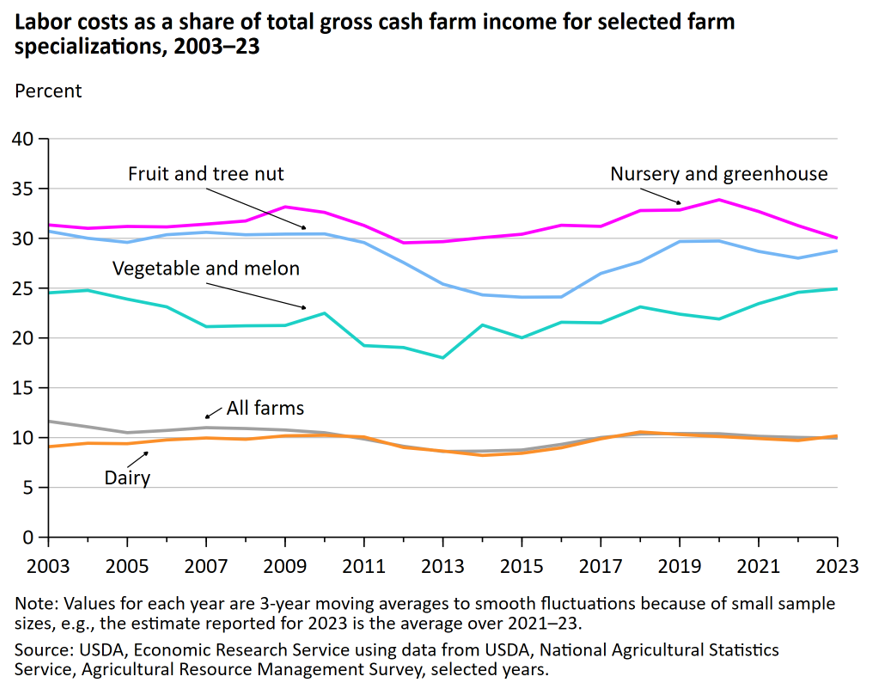
It’s an important concern. Overall, farm labor represents about 14 percent of farming costs. It’s lower in less labor-intensive operations, such as row crop farming. But for specialty crops that require individualized engagement in tending, harvesting, and sorting, labor costs can be much higher – up to 30 percent or more.
Many fruit and vegetable farmers are going out of business, or turning to less labor intensive crops due to the worker shortage. Those fruits and veggies we all enjoy come with a substantial labor component in their prices.
 In the current market environment facing farmers, saving pennies wherever possible is a major consideration. The cost of crop inputs, energy and labor are key factors in profitability – and survival. As costs for fertilizer and other inputs rise, energy costs soar and overall inflation eats away at household financial security, farmers simply can’t afford to ignore the labor challenge. The face of farming is changing. It simply has to in order to survive.
To understand what’s driving this evolution in farming, let’s start with some of the facts about the importance of labor on the farm.
The Bureau of Labor Statistics places the number of agricultural workers at 812,600 in 2024. About 90 percent of those jobs are on the farm or ranch, or in nurseries, greenhouses, or aquacultural operations.
By 2034, the BLS projects that the overall number will decline to 790,200. The farm and ranch worker group will suffer the biggest decline, losing about 28,000 jobs. Agricultural equipment operators, in contrast, are expected to see an 8 percent increase in jobs in that timeframe.
Aging Workforce on Farms
Compounding labor matters is the fact that our farm workforce is growing older.
The Department of Agriculture places the average age of a U.S. farmer at 58 years, making it the oldest workforce in our national economy. Two of every five acres of U.S. farms are owned by people 65 or older. About 40 percent of all farmers are 65 or older.
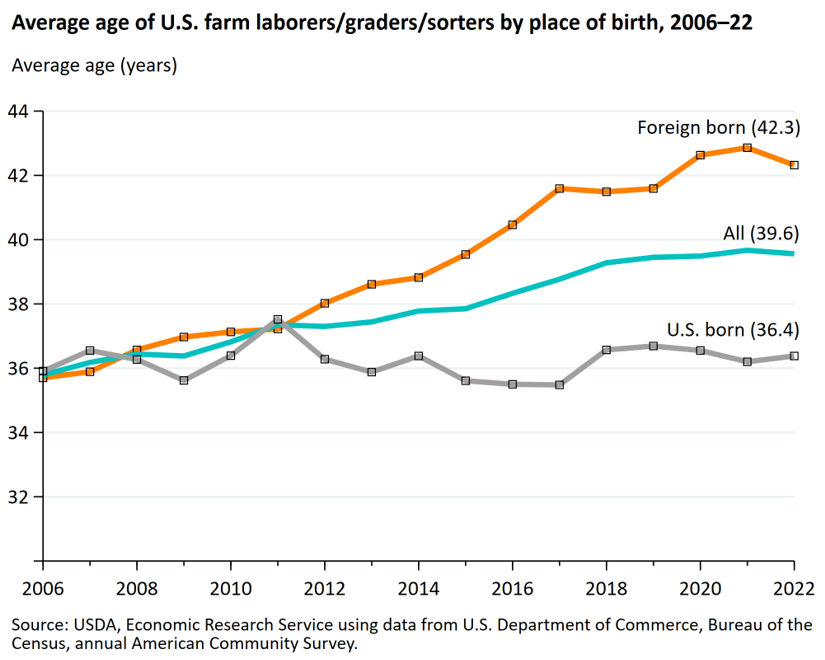 Much of the farm labor force also shows signs of aging – especially the immigrant workers on which our system depends. The average age of an immigrant worker in U.S. agriculture is roughly 42 years, and has been rising steadily as fewer younger immigrants enter the agricultural labor force.
The aging phenomenon extends into other parts of the food chain, too.
According to FTI Consulting, “The food processing industry has seen a significant increase in the percentage of workers aged 60 to 69. One-third of the food manufacturing workforce is over 55, as younger generations are less inclined to pursue careers in food manufacturing, which they perceive as labor-intensive, low-paying, and/or lacking opportunities for advancement.”
In simple terms, our ag system is aging as fewer people seem willing to take on the intensive labor jobs we traditionally associate with farming and food processing.
As AgAmerica recently commented, “There are four times the number of producers who are 65 years or older than those younger than 35. As more operators reach retirement age, there are fewer young farmers coming in to fill their shoes.
‘It only makes sense that the decline in farm labor would follow a similar trend.”
The Brutal Effects of a Demanding Job
To add to the various significant challenges, farmers also suffer from higher rates of suicide than other professions and were also disproportionately affected by the opioid crisis.
In a 2025 study by Rosalie Eisenreich and Carolyn Pollari, the National Rural Health Association notes that rural populations have a significantly higher suicide rate than urban areas, with the suicide rate among farmers over three times higher than the general population.
In particular, male farmers, ranchers and other agricultural managers have a significantly higher rate of suicide deaths at 43 per 100,000, versus the average of 27 across all other occupations.
As for the opioid epidemic, much of it can be attributed to injuries incurred from such demanding labor. Every day in this nation, approximately 100 agricultural workers suffer an injury leading to lost work time. In recent years, the highest number of injuries was among aging farmers age 50-59 years.
In the 2000s, the tides turned with the assistance of an effective and readily available painkiller. Suddenly those injuries felt less severe, allowing workers to once again resume a steady paycheck. But at the devastating cost of addition and death for many.
The Pennsylvania Office of Rural Health cited the following from Lancaster Farming in 2022:
“The scope of the crisis in rural America was staggering, with 74% of farmers and farmworkers reporting they had been directly impacted by opioids, three in four farmers saying it was easy to access large amounts of opioids without a prescription, and one in three adults saying addiction treatment was readily available.”
Michigan State University reports a more specific detail, citing from the Centers for Disease Control that 26% of farmers and farm workers have abused, been addicted or have taken an opioid without a prescription.
The Immigrant Issue
As the government’s statistics indicate, alien and immigrant workers play a major role in farming.
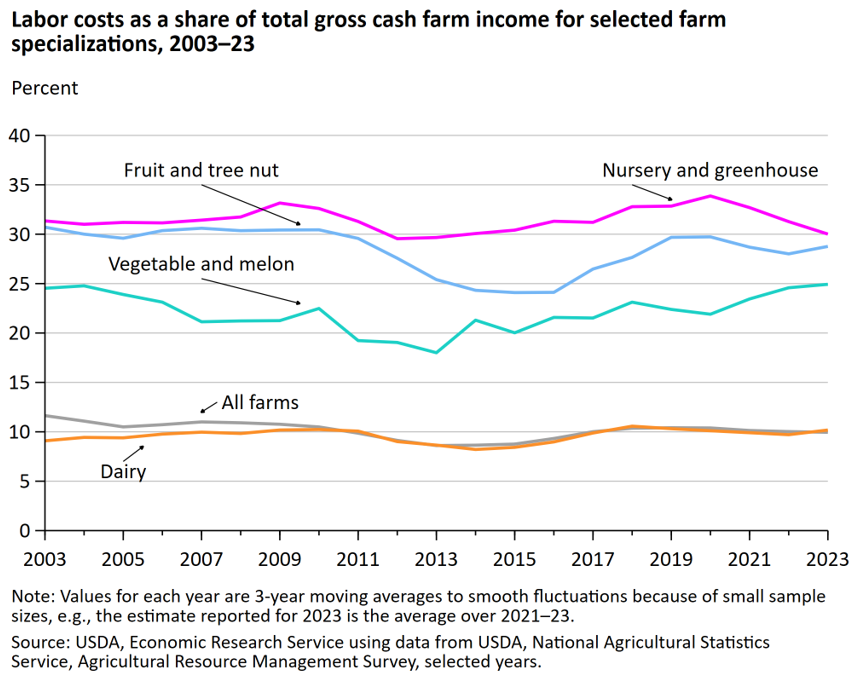 Fruit and vegetable production is notably labor-intensive, and often seasonal. But other sectors – such as dairy and poultry – also demand lots of plain old hard labor. Further down the food chain, processing operations (notably meat and poultry) depend heavily upon immigrant labor.
Government efforts to identify and deal with illegal immigrants have added to the pressures facing farmers and others across the food chain.
Estimates of the proportion of illegal immigrants in the agricultural workforce vary, often by significant amounts, possibly reflecting different political perspectives. But whatever the numbers cited, the number of illegal immigrants working in our food system is sizable.
As noted by farmonaut.com, the percentage of undocumented immigrants in agriculture is, by every credible estimate, extraordinarily high compared to any other major U.S. industry.
As of 2025:
- Undocumented immigrants constitute approximately 50% to 70% of the national agricultural workforce.
- Out of an estimated 2.4 million farmworkers nationwide, about 1.2 to 1.7 million are undocumented.
- Key crops and sectors—including fruits, vegetables, nuts, and perishables—are especially reliant on undocumented labor.
Other organizations report similar reliance on immigrant – often undocumented – workers. As reported by the American Immigration Council in 2021:
As recently as 2019, almost half of all agricultural workers were foreign-born and more than one-fourth (27.3 percent) were undocumented.
Among workers in crop production, the share of foreign-born workers is even higher. In 2019, almost 57 percent of crop production workers were immigrants, including 36.4 percent who were undocumented.
More recent data from AgAmerica place the share of immigrants in the farm labor force at 42 percent, down from 55 percent in 2001.
H-2A to the Rescue?
One major tool for combating the farm labor shortage has been the H-2A visa program. Called the Temporary Agricultural Program, H-2A allows foreign-born workers to enter the United States for up to 10 months.
H-2A has been extremely valuable to crop producers for help with their seasonal – often labor-intensive – tasks. Most livestock producers, such as ranches, hog and poultry operations, and dairies, cannot use the program, however.
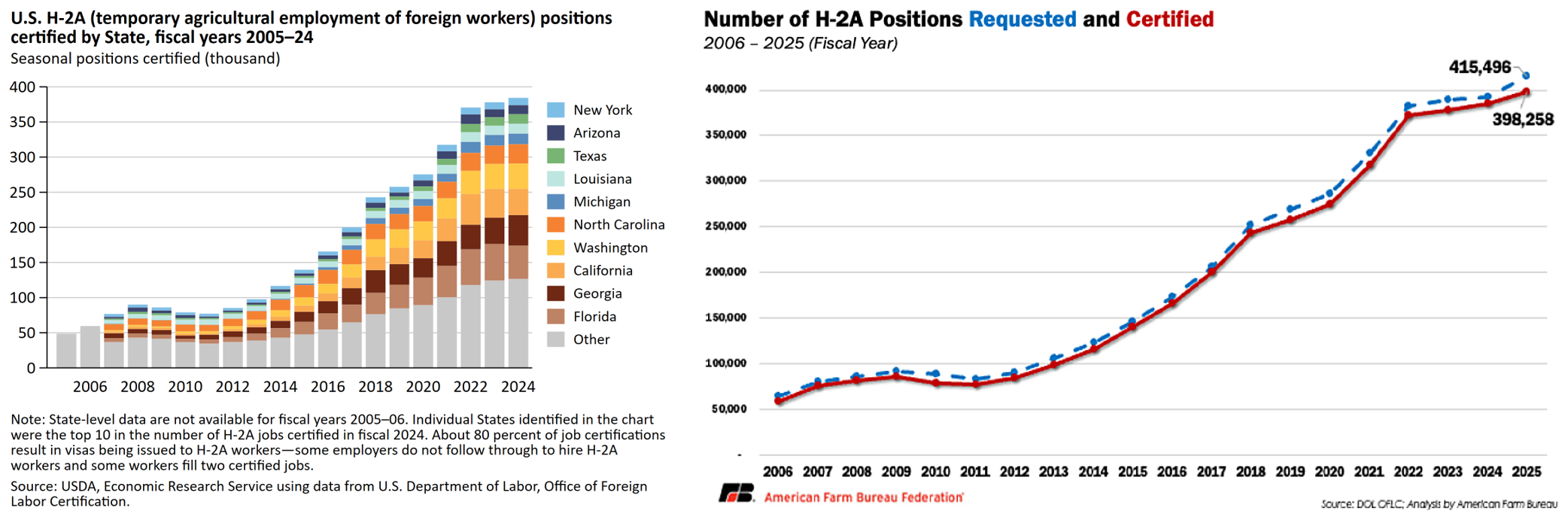
In fiscal 2025, the government issued almost 400,000 H-2A visas, up from roughly 48,000 in 2005. Almost half of those visas went to five states.
The American Farm Bureau reports that “only 182 positions out of over 415,000 advertised (jobs) received a domestic applicant in fiscal year 2025.”
In other words, H-2A visas go for jobs that domestic workers simply don‘t want.
The Response – Economic and Otherwise
Traditional approaches to attracting and training farm workers continue unabated.
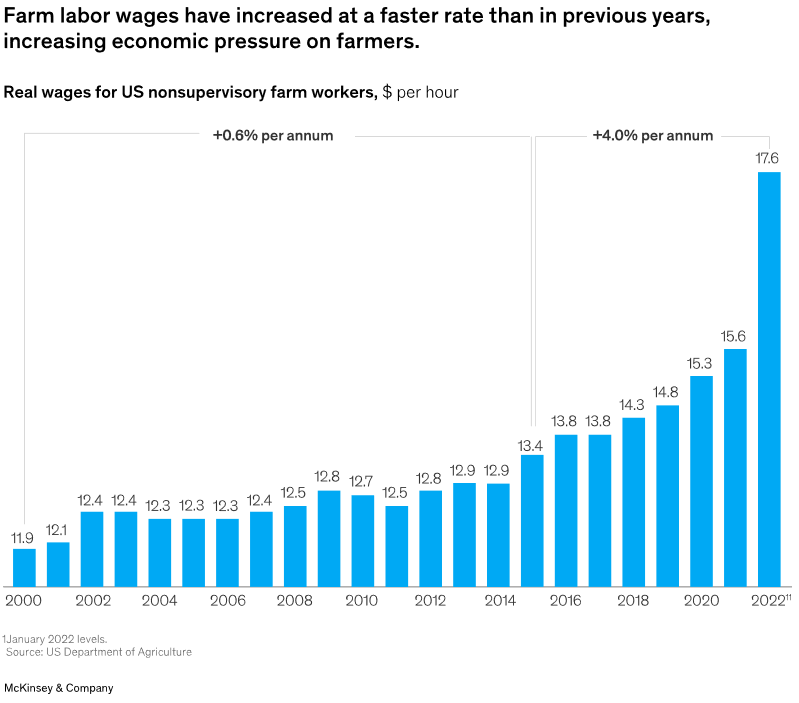 Wages paid to farm laborers have increased steadily in recent years in an attempt to attract workers, adding to costs and further dampening farmers’ bottom lines.
Schools, extension programs, and private commercial interests collectively seek to raise awareness of the nobility of being at the front lines of feeding a hungry world.
They help people see the wide career opportunities available across the food chain. They provide the training and encouragement that brings new and young people into the business and lifestyle of farming.
The Future Farmers of America (FFA), as one of the most recognized agents in this effort, remains a powerful engine for assuring farming’s future. This kind of effort helps explain why the 2022 Census of Agriculture showed the largest jump in farmer numbers came from people under the age of 25.
But one additional response to the labor challenge looms over all the others. Its name is technology.
Next week, we will continue to examine the role of labor in our food system – and the remarkable ways technology is reshaping the face of farming and food production.
The Bottom Line
Technology already is changing the face of farming and many aspects of food processing. Automation, robotics, drones, and artificial intelligence are steadily becoming more and more ingrained in our food system – in ways we may not yet fully recognize or appreciate.
Share this article



Listen to the Dirt to Dinner Podcast